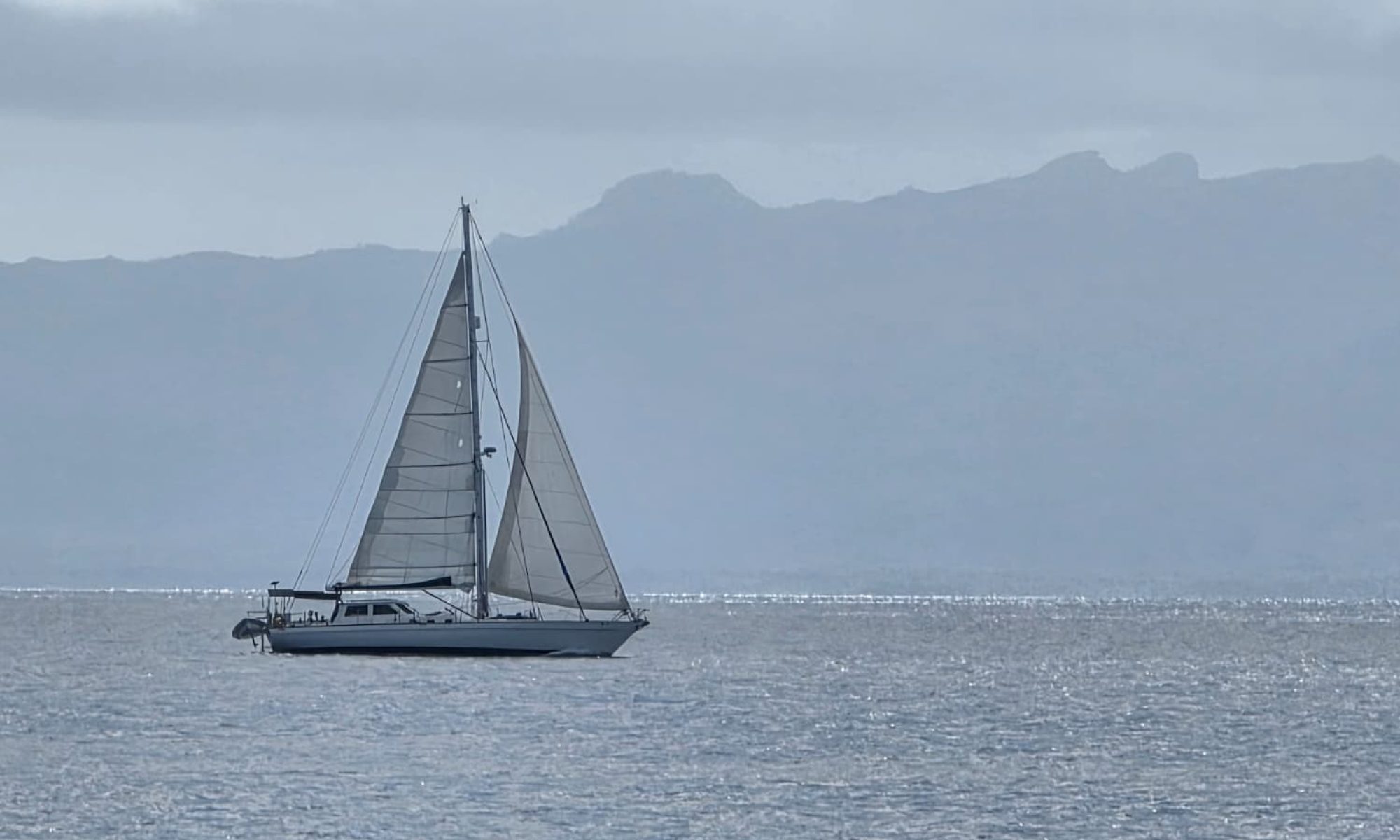


Hi there to everyone! Welcome to another instalment of the Azimuth blog. Last time we told you a bit about Savusavu, and setting off to explore the Island of Vanua Levu. This time we carry on exploring the more remote North coast of the Island and end up back in Savusavu again completing a circumnavigation of Vanua Levu.
So we sat in Bula Bay for quite a few days.

I shot this video when I went out to explore the the beaches around the area. I found out from one of the fisherman that a TV show was actually shot in the area, Fiji:Survivor. So as I was exploring, I kind of had that romantic notion of being on a deserted island and having to fend for myself. I think a diet of coconuts would not have been a problem!
Its a special place this Northern part of Fiji. There is no tourism, that is more confined to the Large Island of Viti Levu to the South. For some reason too, there are very few boats visiting as well. That makes us somewhat of a spectacle to the local people, and to the North East of Bula bay there are two or three populated Islands with small villages where people live a very simple subsistence life. They were regularly passing by on long boats and waving.
One day we had a visit from a couple of fisherman in their long boat, Tukeni and his nephew Dumay. They were a lovely couple of guys and we invited them on board to have a look and have a cup of tea with us. Tukes spotted my guitar on the wall and insisted I play them something, so I dusted off an old Pogues tune and sang them that, and then to our great delight, Tukes picked up the guitar and he and Dumay treated us to a song too

We had an instant bond through music! They were headed to the local shop, which is about 4 miles away from Bula Bay up the Wainikoro River, and they very kindly offered us a lift so we can get some provisions too. I took this video!
It was a very cool journey, doing 30 knots up the river on their long boat.


We got back to Azimuth an hour or so later, we had bought the guys a big tub of Ice Cream for them and their families back at the village, so we put that in our freezer whilst Tukes and Dumay went off fishing all afternoon. They returned later to collect it, and invited us to join them for Sunday Lunch at their village the next day!
What a treat! We pulled up the anchor and headed to Duradura Island the next morning, In Fijian, Na Dura is the word for a double hulled canoe.


We were firstly greeted by a local boat full of children who wanted to come on board! It was a hair raising moment when a little girl nearly managed to get her dress tangled up in one of our electric winches! And then Tukes turned up to show us where to anchor off the village. As far as we can tell, no other cruising yachts like Azimuth have ever visited the village before? It was a tight entrance to the anchorage through the reef and so we had to rely on Tukes’ local knowledge as we were totally “off chart”!


We dropped the anchor and then Tukes took us to shore across the very shallow reef to his house in the village to meet his family, his wife Sasa and his boy Junior. What a pleasure to be invited in to their home, a place Tukes was very proud of, and so he should be, he had built the place with his own hands.
The meal was delicious with fresh fish caught the day before, a coconut sauce to accompany it, kasava root ( a bit like potato) and a kind of seaweed in coconut dish (which I forget the Fijian name of) that had the consistency of a set jelly, but very tasty with garlic. All washed down with milky tea!


We spent a lovely afternoon with Tukes and Sasa and their extended family and friends, taking about their lives and the challenges they face and our lives back in the UK and our children and what they are doing. Power is one of their biggest challenges. They are not connected to any power grid, so they have to rely on generators. And the shop is 10 nautical miles by boat, to get fuel. The only money Tukes can earn comes from the sea and selling fish. He was desperate to have a freezer, so that he didn’t have to sell the catch he made that day, but could store his catch and also sell ice to the village.
We took a walk round the village with Tukes son in the afternoon, and I noticed that every house had a solar panel, but most of them just had the wires hanging down, not connected to anything. It seems that a government project installed solar panels on each house back in 2012, so that people had lights, but all the systems were now broken, or the car battery for each system was worn out. There had been no aftercare on the system for many years. It was hard to see, that in such a sunny country, that people were still reliant on burning fossil fuels to light their homes.


Tukes asked me about the solar system we had on the boat, and i explained about it. I said that I would return the next day and come and do some testing in the village to see if the panels still worked and test the various systems to see if I could help to get them to work again. So the next afternoon we came back to the village and I bought my multi-meter. Junior took me round many of the houses, and I tested all the systems. All of the solar panels still worked, and most systems had little 300W solar controllers that looked fine too. Most of the systems were in a terrible state, all the wires either corroded or removed. All of the car batteries were completely dead!
If they could get their hands on a new battery, for about 40 quid, each house would no longer need to use generators for lights. We explained this to each house. However, the sad fact is that even getting the money for a new battery would be difficult for many of the people.
When I got back to the boat that night, I was trying to think how I could at least help Tukes get a basic solar system setup, and then when others saw it, they might be inspired to follow suit. I remembered that I had an old 12V inverter in my spares box, a simple 350W unit with a single universal socket and a USB socket. I gave it to Tukes, and told him to get one of the spare solar panels that weren’t being used in the village and a solar controller. I bought another broken solar panel back to the boat and resoldered it, so that it was fixed.
The next day we returned to the village and Tukes took me to the Church where we met the pastor.


The church had a functioning solar panel, solar charger and battery that was not connected to anything. So I hooked up the inverter, and plugged in the lights in the church and showed them working! Everyone was very happy. The church had to run a generator just to light the building, and I had shown them that they already had what they needed, just a simple inverter would mean that they didn’t need to use a generator anymore.
Tukes was impressed too, and he had sorted out getting the solar panel I had requested and had managed to find a car battery that he thought was working, so we returned to his house, and I wired up the system for him consisting of 2 40W solar panels in series connected in parallel to a larger 100W panel in to a solar controller, and then to the car battery. When I connected up the inverter I had given him, it worked!
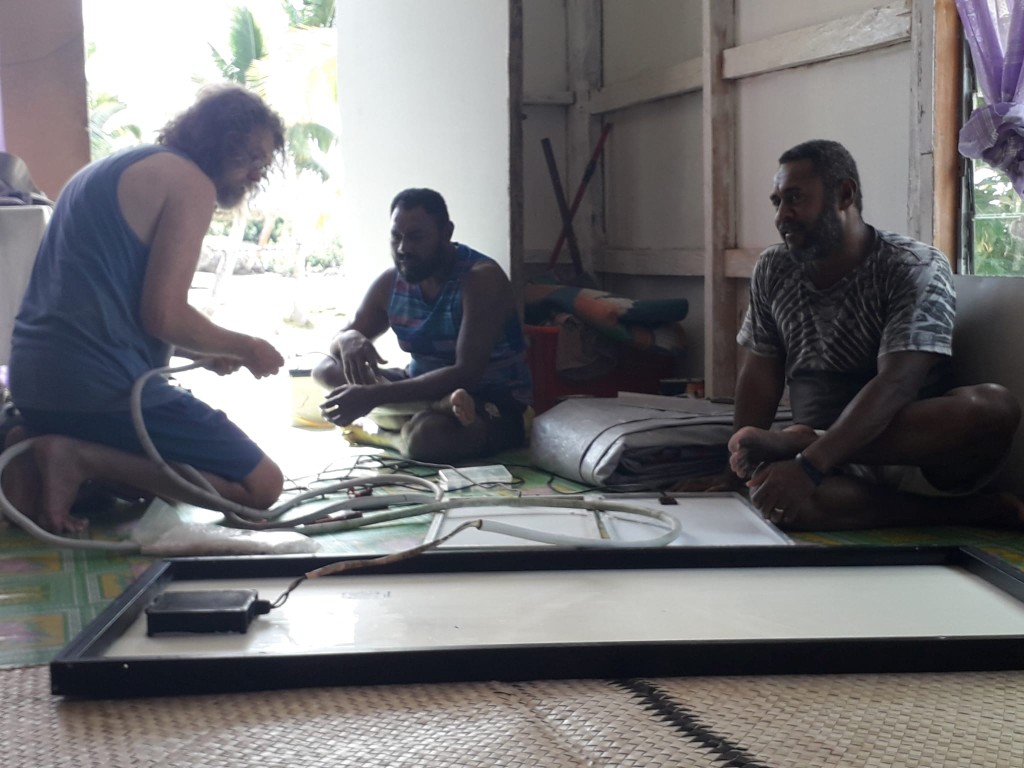


While I was doing it, I tried to show them what I was doing, so they could learn a little bit about how it works. He was very happy, and so was I! It was capable of lighting the whole house. I hope I managed to make a small difference to him and his families welfare. At least now he can light his house and charge his phone without having to run the generator. He wants to expand it so that he can run a freezer next, and we are friends on Facebook, so I can offer him some help when the time comes.
We had lots of visitors to the boat during our stay at Salevukoso Village. No one had seen a yacht, and so we hosted 7 or 8 people at a time, at all hours of the day or evening! They would just turn up whenever, boats full of fisherman, and sometimes their wives and children too. The most entertaining thing on board turned out to be the binoculars! Everyone thought they were amazing!


I think we stayed 4 nights before we moved on again. It was a wonderful experience to meet Tukes and his family and all the other people in the village and one that we wont forget. in a hurry. But we had start moving back towards Savusavu, to collect boat parts and our passports.
The sailing along the north coast was magnificent! All of it was downwind, on crystal clear flat seas, inside of the outer reef. The navigation was not easy. I didn’t trust the charts at all until we got to an area where there was a recommended route marked. Many areas were full of patches of shallow coral where a mistake would mean disaster for Azimuth, so I had to be extra vigilant and rely greatly on the depth sounder. Charted depths were a nonsense especially when we approached anchorages. So it was all mark one eyeball and depth sounding at low approach speeds.
The day we left Salevukoso I had to navigate through narrow reef to get back to my previous track, and then we had a lovely sail down to a bay surrounded by mangroves at a place called Tivi, where we dropped the anchor in 5m in mud.


We saw some people on boats, but we enjoyed a little peace and quiet after the mad few days we had at Salevukoso.
Finally we had some good news from home too! Our passports had arrived back in Nottingham, and Vinnie happened to be staying with Ailsa’s mum, so he organised getting them sent to Fiji using DHL, top man! Also, we finally got our house back from our unruly tennant after a battle of over a year. Such a relief. Vinnie and his friend Thomas have done some work to tart up the place and as I write this its finally gone on the market.
We both felt some relief with that news, I think we have both been stressed out about it, especially as the tenant refused to pay any rent for 6 months. These things are sent to try you, but now we can move forward at last finally make the place work for us.
After another night at anchor, we took the wind for a slow sail further down the coast with a plan to anchor off the town of Labasa, the biggest place on Vanua Levu.


The wind was very light until we reached the place to anchor, and then the wind whipped up to 25 knots at the sea got rough. We thought better of it and decided to skip Labasa, and plan to return by bus or car at a later date. We headed to the next anchorage, but that was untenable too, so looking at the satellite map, I spied an island a few miles off shore called Cukina Island, and we headed there to find flat seas and lighter winds behind a flat Island of Mangroves and we dropped the hook for a peaceful night.


The next morning, I took the canoe out to explore. The satellite map showed that Cukina was barely above sea level and covered in Mangroves except for a large tidal lake inside that looked to connected by small channels to the sea. I shot this video:
It was quite a place to explore, like nothing I had ever seen before. The mangroves feel quite alien. The wildlife here in Fiji is unspoilt and is thriving.
Later that morning we set sail again on a windy day. Vanua Leve has large mountains and the wind was forming acceleration zones where we would be sailing in 10 knots of wind and then it would accelerate to 30 knots whisking us along, all on flat seas. Alot of fun. You could see distinct wind lines on the water and white caps where these zones formed. We noted that most were near the mountainous shorelines, reminiscent of the Marlborough sounds in New Zealand.


The next anchorage looked to be right in one of those zones, so we carefully picked a route through some reefs and dropped the hook off Macuata-I-Wai Island in another uncharted spot. We are starting to realise how much fun it is to find these uncharted anchorages. This was another idyllic spot anchored off a beach that at low tide extended a long way off shore.


We spent a couple of nights here, so I got the canoe out to go and explore. I shot this video:
It feels amazing to have places like this all to yourself to explore. We are very lucky.
We were keeping an eye on DHL tracking, and I watched our passports start their journey from East Midlands, via Germany, Hong Kong, and Sydney until they reached Fiji!
The next sail took all day in light winds down the coast through spectacular scenery. I times, if it hadn’t been for the blazing sun, I would have sworn we were in Scotland!


All those reefs kept me on my toes all day for navigation though and that night we dropped the anchor in a huge bay called Galoa Bay for another peaceful night at anchor.

Another amazing sail the next day had us leave the North side of Vanua Levu and heading down the west coast, past dramatic and through more narrow channels in the reef until we arrived at Baulailai Bay.


Another superb anchorage that we again had to ourselves with crystal clear waters and a beach lined with coconut palms


Here’s another fun video for you. The footage is an amalgamation of all the sails we did along the north coast from Bula Bay, some footage from anchorages too, but the sound track is spoken word to music with some tongue in cheek extracts and summary of my book Sailing Planet Earth. Hope you like it! I have been revisiting my old music writing hobby with the help of Suno, so actually all the music in my videos in this post is written by me.
We had a couple of nights in Baulailai Bay until I checked that both our packages had arrived in Nadi in Fiji, and were on their way to Savusavu. So it was time to get going, and we were still 60 odd miles away. We set off to the next anchorage, this time motoring through glassy flat seas and then getting hit by strong winds on the nose coming round the South West corner of Vanua Levu.


We dropped the hook in what felt like open ocean in a pocket in the reef at a place called Coconut Point.
Now I was dreading the next 45 miles of sailing as it promised to be a beat hard on the wind. However, my fears were ill founded. We had two of the best days of upwind sailing we have ever had on Azimuth. The first passage 15 to 20 knots at 35 to 40 degrees apparent whisked is in two tacks across the first bay to a superb anchorage at Wainunu Bay.
The next morning we had to motor through a narrow passage in the reef and out in to the open ocean which was rougher than the day before, but we had the same wind conditions and a great sail all the way to Savusavu. The last 5 miles were flat seas again as we entered the protection of the reef and we whisked along at 7 to 8 knots. Our friends on Barbarella were anchored in the Cousteau resort just outside Savusavu and took these pictures of us on the way in. Thanks to them!
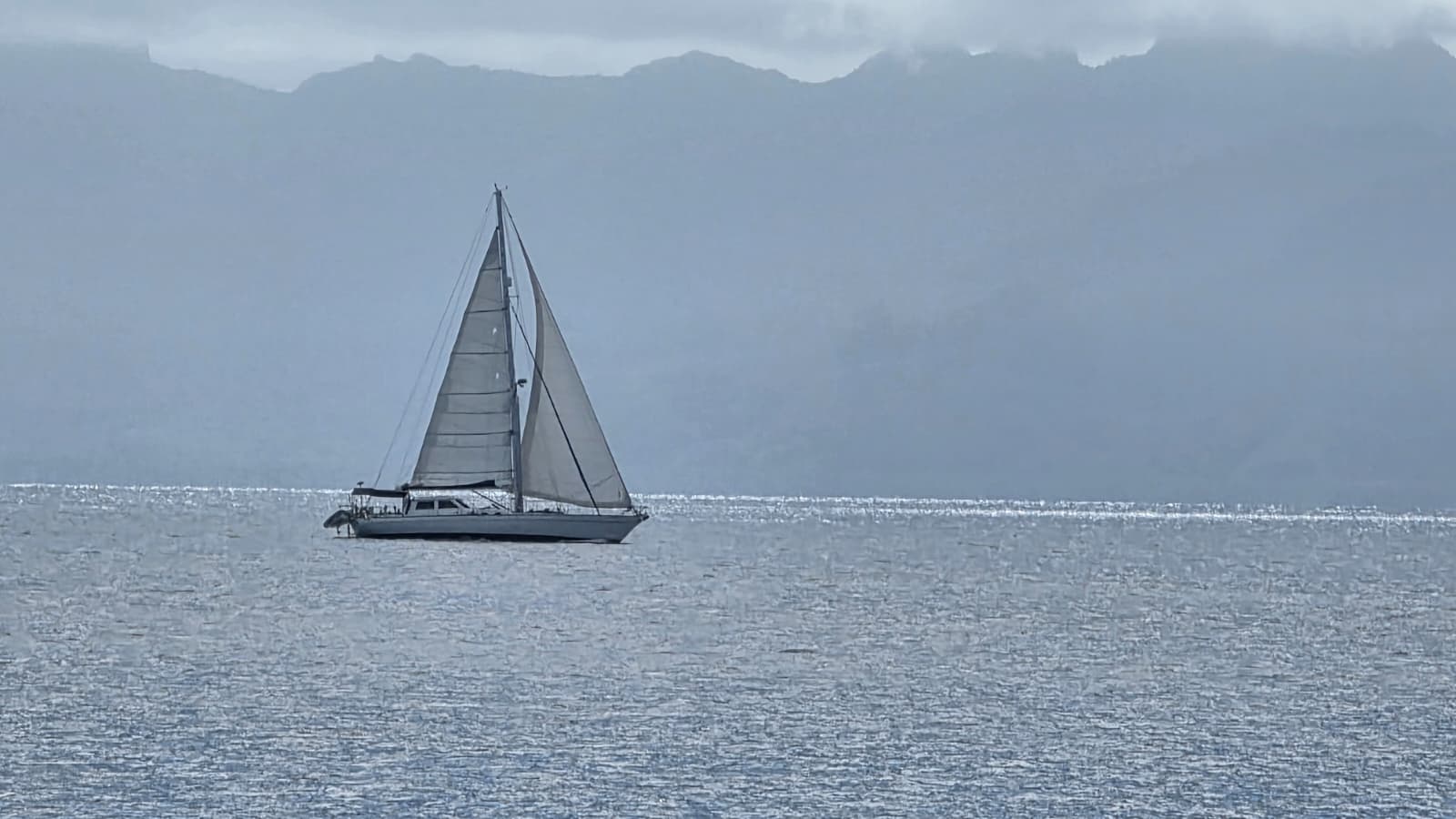
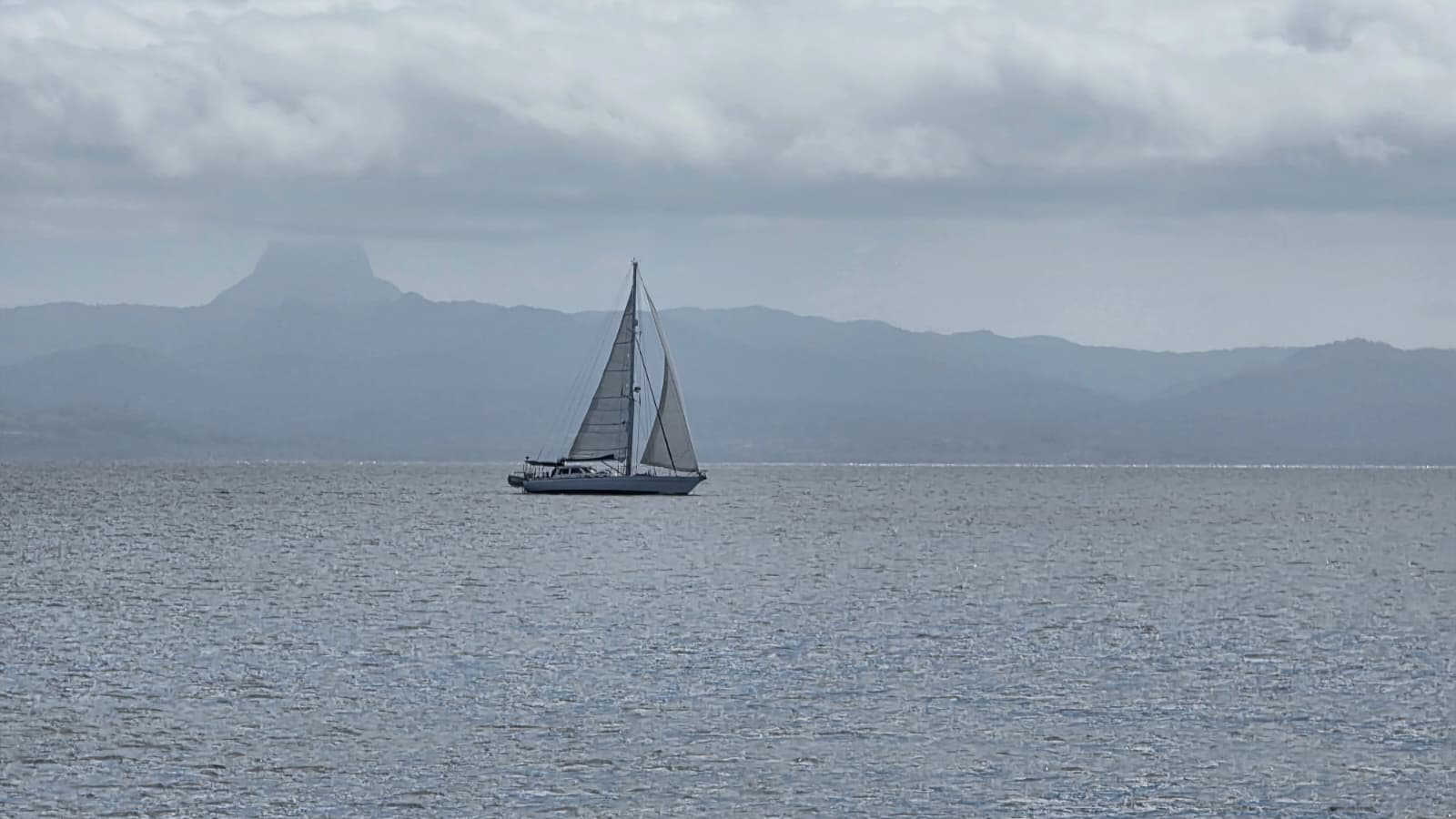

Circumnavigation of Vanua Levu was complete

Just as we arrived at Savusavu, we got a message to say our parcels had been delivered and we picked up a mooring buoy and headed to the DHL office to collect our passports! All very easy, and a massive relief!
So here we are back in Savusavu as I write this. The weather is pretty awful at the moment, so we are pottering around and not doing much. Still haven’t decided where to go next!
Dom and Ailsa on Azimuth
You two have been busy. I am glad you got your house in the UK sorted out. Great videos. Good afternoon watching. Take care, Doug. Maria sends her love xxx
What a wonderful video.
Loved watching and listening to it.
Called in to see your mum Ailsa.
She rustled up lunch for us and we spent a lovely couple of hours chatting and laughing.
Carry on enjoying your wonderful life.
Wendy