Exploring the Remote North Coast of Vanua Levu

Hi there to everyone! Welcome to another instalment of the Azimuth blog. Last time we told you a bit about Savusavu, and setting off to explore the Island of Vanua Levu. This time we carry on exploring the more remote North coast of the Island and end up back in Savusavu again completing a circumnavigation of Vanua Levu.

So we sat in Bula Bay for quite a few days.

I shot this video when I went out to explore the the beaches around the area. I found out from one of the fisherman that a TV show was actually shot in the area, Fiji:Survivor. So as I was exploring, I kind of had that romantic notion of being on a deserted island and having to fend for myself. I think a diet of coconuts would not have been a problem!

Its a special place this Northern part of Fiji. There is no tourism, that is more confined to the Large Island of Viti Levu to the South. For some reason too, there are very few boats visiting as well. That makes us somewhat of a spectacle to the local people, and to the North East of Bula bay there are two or three populated Islands with small villages where people live a very simple subsistence life. They were regularly passing by on long boats and waving.

One day we had a visit from a couple of fisherman in their long boat, Tukeni and his nephew Dumay. They were a lovely couple of guys and we invited them on board to have a look and have a cup of tea with us. Tukes spotted my guitar on the wall and insisted I play them something, so I dusted off an old Pogues tune and sang them that, and then to our great delight, Tukes picked up the guitar and he and Dumay treated us to a song too

We had an instant bond through music! They were headed to the local shop, which is about 4 miles away from Bula Bay up the Wainikoro River, and they very kindly offered us a lift so we can get some provisions too. I took this video!

It was a very cool journey, doing 30 knots up the river on their long boat.

We got back to Azimuth an hour or so later, we had bought the guys a big tub of Ice Cream for them and their families back at the village, so we put that in our freezer whilst Tukes and Dumay went off fishing all afternoon. They returned later to collect it, and invited us to join them for Sunday Lunch at their village the next day!

What a treat! We pulled up the anchor and headed to Duradura Island the next morning, In Fijian, Na Dura is the word for a double hulled canoe.

We were firstly greeted by a local boat full of children who wanted to come on board! It was a hair raising moment when a little girl nearly managed to get her dress tangled up in one of our electric winches! And then Tukes turned up to show us where to anchor off the village. As far as we can tell, no other cruising yachts like Azimuth have ever visited the village before? It was a tight entrance to the anchorage through the reef and so we had to rely on Tukes’ local knowledge as we were totally “off chart”!

We dropped the anchor and then Tukes took us to shore across the very shallow reef to his house in the village to meet his family, his wife Sasa and his boy Junior. What a pleasure to be invited in to their home, a place Tukes was very proud of, and so he should be, he had built the place with his own hands.

The meal was delicious with fresh fish caught the day before, a coconut sauce to accompany it, kasava root ( a bit like potato) and a kind of seaweed in coconut dish (which I forget the Fijian name of) that had the consistency of a set jelly, but very tasty with garlic. All washed down with milky tea!

We spent a lovely afternoon with Tukes and Sasa and their extended family and friends, taking about their lives and the challenges they face and our lives back in the UK and our children and what they are doing. Power is one of their biggest challenges. They are not connected to any power grid, so they have to rely on generators. And the shop is 10 nautical miles by boat, to get fuel. The only money Tukes can earn comes from the sea and selling fish. He was desperate to have a freezer, so that he didn’t have to sell the catch he made that day, but could store his catch and also sell ice to the village.

We took a walk round the village with Tukes son in the afternoon, and I noticed that every house had a solar panel, but most of them just had the wires hanging down, not connected to anything. It seems that a government project installed solar panels on each house back in 2012, so that people had lights, but all the systems were now broken, or the car battery for each system was worn out. There had been no aftercare on the system for many years. It was hard to see, that in such a sunny country, that people were still reliant on burning fossil fuels to light their homes.

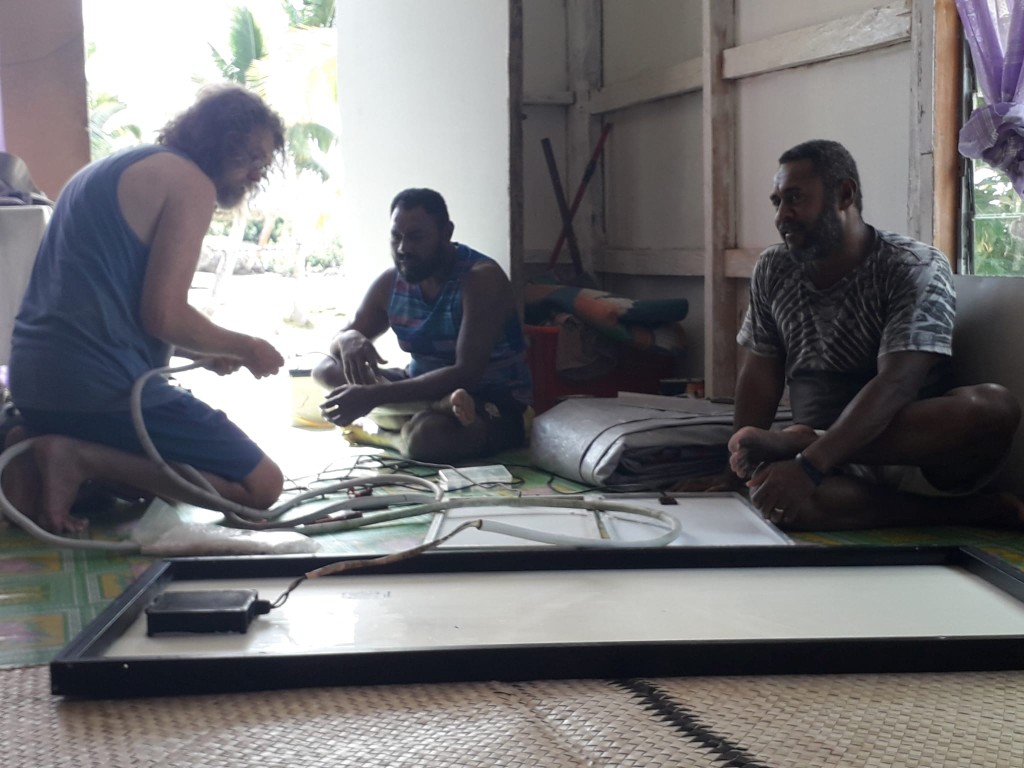
Tukes asked me about the solar system we had on the boat, and i explained about it. I said that I would return the next day and come and do some testing in the village to see if the panels still worked and test the various systems to see if I could help to get them to work again. So the next afternoon we came back to the village and I bought my multi-meter. Junior took me round many of the houses, and I tested all the systems. All of the solar panels still worked, and most systems had little 300W solar controllers that looked fine too. Most of the systems were in a terrible state, all the wires either corroded or removed. All of the car batteries were completely dead!

If they could get their hands on a new battery, for about 40 quid, each house would no longer need to use generators for lights. We explained this to each house. However, the sad fact is that even getting the money for a new battery would be difficult for many of the people.

When I got back to the boat that night, I was trying to think how I could at least help Tukes get a basic solar system setup, and then when others saw it, they might be inspired to follow suit. I remembered that I had an old 12V inverter in my spares box, a simple 350W unit with a single universal socket and a USB socket. I gave it to Tukes, and told him to get one of the spare solar panels that weren’t being used in the village and a solar controller. I bought another broken solar panel back to the boat and resoldered it, so that it was fixed.

The next day we returned to the village and Tukes took me to the Church where we met the pastor.

The church had a functioning solar panel, solar charger and battery that was not connected to anything. So I hooked up the inverter, and plugged in the lights in the church and showed them working! Everyone was very happy. The church had to run a generator just to light the building, and I had shown them that they already had what they needed, just a simple inverter would mean that they didn’t need to use a generator anymore.

Tukes was impressed too, and he had sorted out getting the solar panel I had requested and had managed to find a car battery that he thought was working, so we returned to his house, and I wired up the system for him consisting of 2 40W solar panels in series connected in parallel to a larger 100W panel in to a solar controller, and then to the car battery. When I connected up the inverter I had given him, it worked!

While I was doing it, I tried to show them what I was doing, so they could learn a little bit about how it works. He was very happy, and so was I! It was capable of lighting the whole house. I hope I managed to make a small difference to him and his families welfare. At least now he can light his house and charge his phone without having to run the generator. He wants to expand it so that he can run a freezer next, and we are friends on Facebook, so I can offer him some help when the time comes.

We had lots of visitors to the boat during our stay at Salevukoso Village. No one had seen a yacht, and so we hosted 7 or 8 people at a time, at all hours of the day or evening! They would just turn up whenever, boats full of fisherman, and sometimes their wives and children too. The most entertaining thing on board turned out to be the binoculars! Everyone thought they were amazing!

I think we stayed 4 nights before we moved on again. It was a wonderful experience to meet Tukes and his family and all the other people in the village and one that we wont forget. in a hurry. But we had start moving back towards Savusavu, to collect boat parts and our passports.

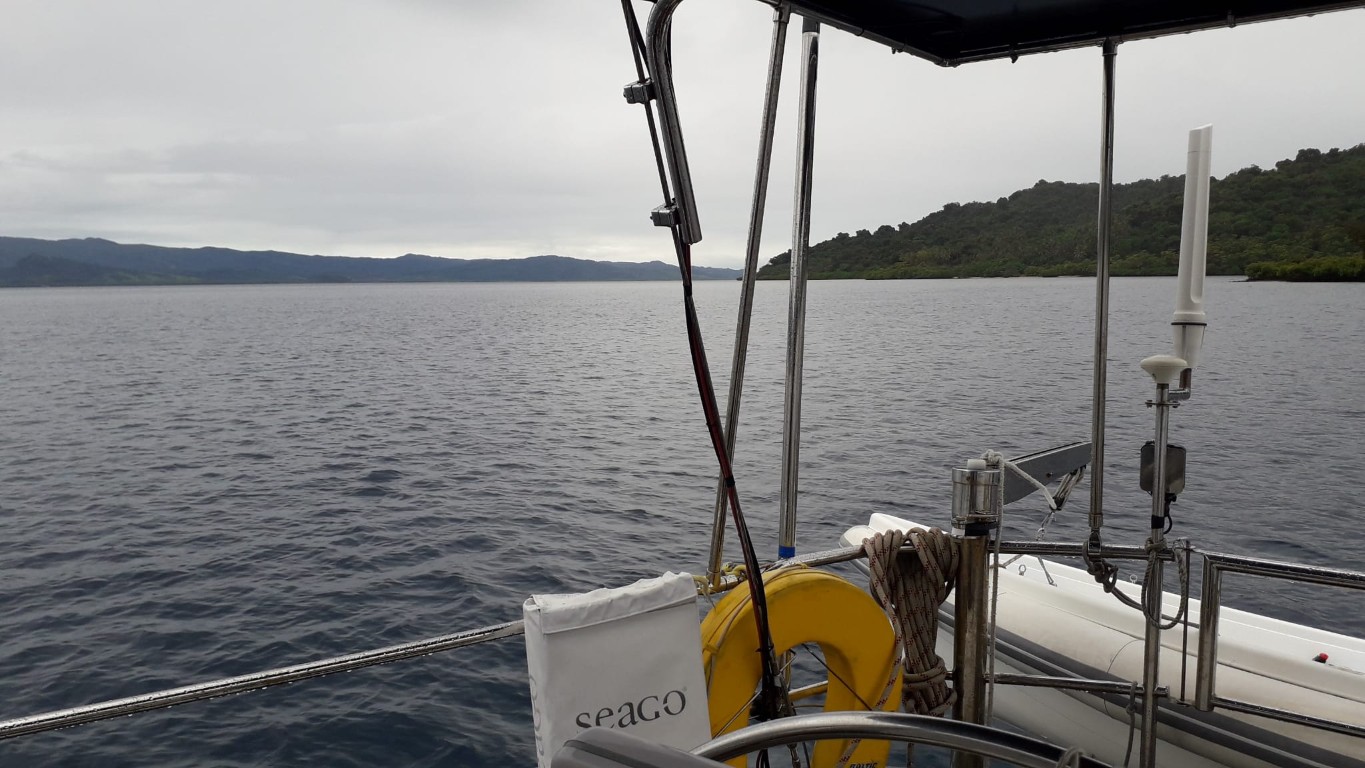
The sailing along the north coast was magnificent! All of it was downwind, on crystal clear flat seas, inside of the outer reef. The navigation was not easy. I didn’t trust the charts at all until we got to an area where there was a recommended route marked. Many areas were full of patches of shallow coral where a mistake would mean disaster for Azimuth, so I had to be extra vigilant and rely greatly on the depth sounder. Charted depths were a nonsense especially when we approached anchorages. So it was all mark one eyeball and depth sounding at low approach speeds.

The day we left Salevukoso I had to navigate through narrow reef to get back to my previous track, and then we had a lovely sail down to a bay surrounded by mangroves at a place called Tivi, where we dropped the anchor in 5m in mud.

We saw some people on boats, but we enjoyed a little peace and quiet after the mad few days we had at Salevukoso.

Finally we had some good news from home too! Our passports had arrived back in Nottingham, and Vinnie happened to be staying with Ailsa’s mum, so he organised getting them sent to Fiji using DHL, top man! Also, we finally got our house back from our unruly tennant after a battle of over a year. Such a relief. Vinnie and his friend Thomas have done some work to tart up the place and as I write this its finally gone on the market.

We both felt some relief with that news, I think we have both been stressed out about it, especially as the tenant refused to pay any rent for 6 months. These things are sent to try you, but now we can move forward at last finally make the place work for us.

After another night at anchor, we took the wind for a slow sail further down the coast with a plan to anchor off the town of Labasa, the biggest place on Vanua Levu.

The wind was very light until we reached the place to anchor, and then the wind whipped up to 25 knots at the sea got rough. We thought better of it and decided to skip Labasa, and plan to return by bus or car at a later date. We headed to the next anchorage, but that was untenable too, so looking at the satellite map, I spied an island a few miles off shore called Cukina Island, and we headed there to find flat seas and lighter winds behind a flat Island of Mangroves and we dropped the hook for a peaceful night.

The next morning, I took the canoe out to explore. The satellite map showed that Cukina was barely above sea level and covered in Mangroves except for a large tidal lake inside that looked to connected by small channels to the sea. I shot this video:

It was quite a place to explore, like nothing I had ever seen before. The mangroves feel quite alien. The wildlife here in Fiji is unspoilt and is thriving.

Later that morning we set sail again on a windy day. Vanua Leve has large mountains and the wind was forming acceleration zones where we would be sailing in 10 knots of wind and then it would accelerate to 30 knots whisking us along, all on flat seas. Alot of fun. You could see distinct wind lines on the water and white caps where these zones formed. We noted that most were near the mountainous shorelines, reminiscent of the Marlborough sounds in New Zealand.

The next anchorage looked to be right in one of those zones, so we carefully picked a route through some reefs and dropped the hook off Macuata-I-Wai Island in another uncharted spot. We are starting to realise how much fun it is to find these uncharted anchorages. This was another idyllic spot anchored off a beach that at low tide extended a long way off shore.

We spent a couple of nights here, so I got the canoe out to go and explore. I shot this video:

It feels amazing to have places like this all to yourself to explore. We are very lucky.

We were keeping an eye on DHL tracking, and I watched our passports start their journey from East Midlands, via Germany, Hong Kong, and Sydney until they reached Fiji!

The next sail took all day in light winds down the coast through spectacular scenery. I times, if it hadn’t been for the blazing sun, I would have sworn we were in Scotland!

All those reefs kept me on my toes all day for navigation though and that night we dropped the anchor in a huge bay called Galoa Bay for another peaceful night at anchor.

Another amazing sail the next day had us leave the North side of Vanua Levu and heading down the west coast, past dramatic and through more narrow channels in the reef until we arrived at Baulailai Bay.

Another superb anchorage that we again had to ourselves with crystal clear waters and a beach lined with coconut palms

Here’s another fun video for you. The footage is an amalgamation of all the sails we did along the north coast from Bula Bay, some footage from anchorages too, but the sound track is spoken word to music with some tongue in cheek extracts and summary of my book Sailing Planet Earth. Hope you like it! I have been revisiting my old music writing hobby with the help of Suno, so actually all the music in my videos in this post is written by me.

We had a couple of nights in Baulailai Bay until I checked that both our packages had arrived in Nadi in Fiji, and were on their way to Savusavu. So it was time to get going, and we were still 60 odd miles away. We set off to the next anchorage, this time motoring through glassy flat seas and then getting hit by strong winds on the nose coming round the South West corner of Vanua Levu.

We dropped the hook in what felt like open ocean in a pocket in the reef at a place called Coconut Point.

Now I was dreading the next 45 miles of sailing as it promised to be a beat hard on the wind. However, my fears were ill founded. We had two of the best days of upwind sailing we have ever had on Azimuth. The first passage 15 to 20 knots at 35 to 40 degrees apparent whisked is in two tacks across the first bay to a superb anchorage at Wainunu Bay.

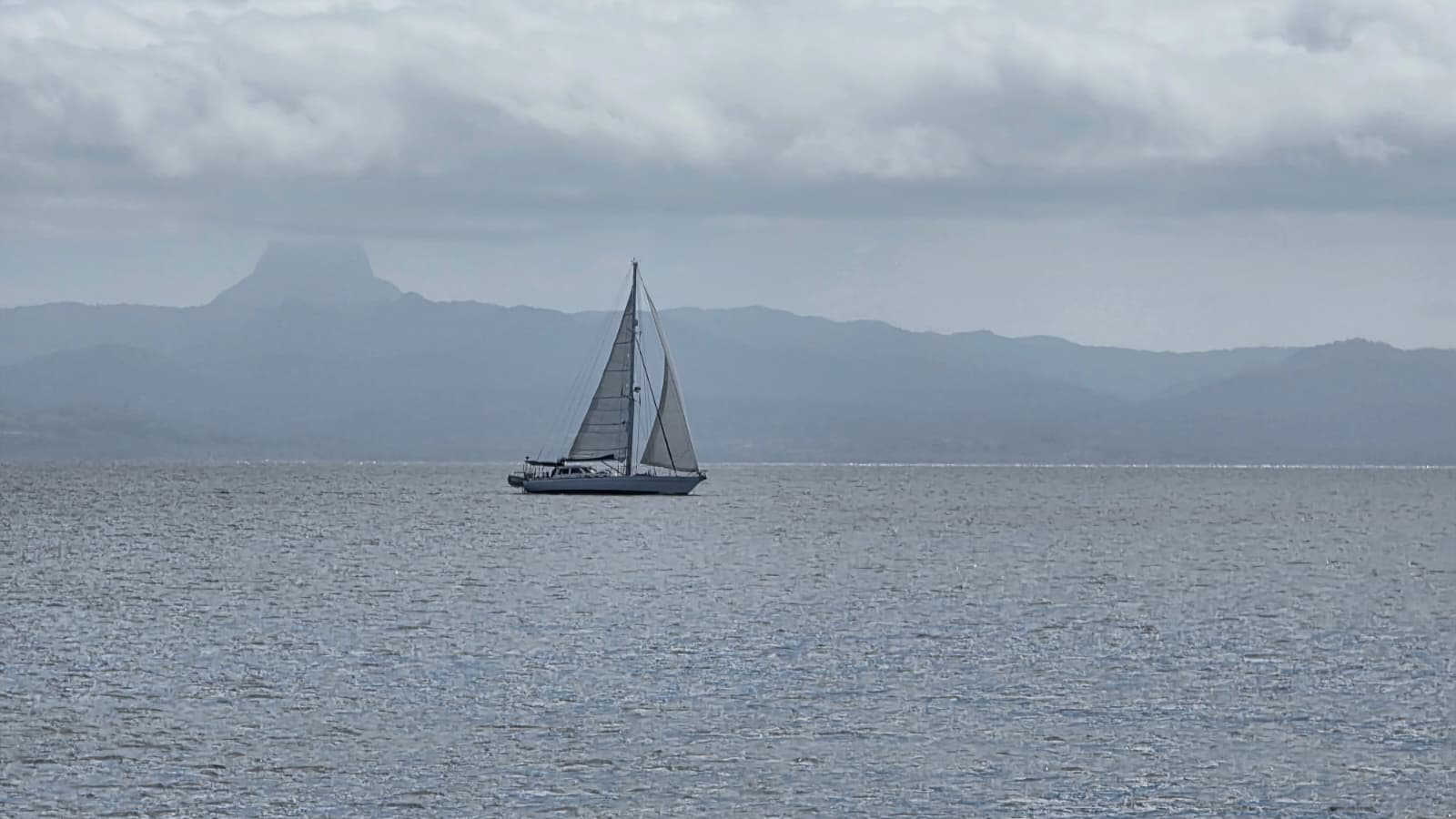
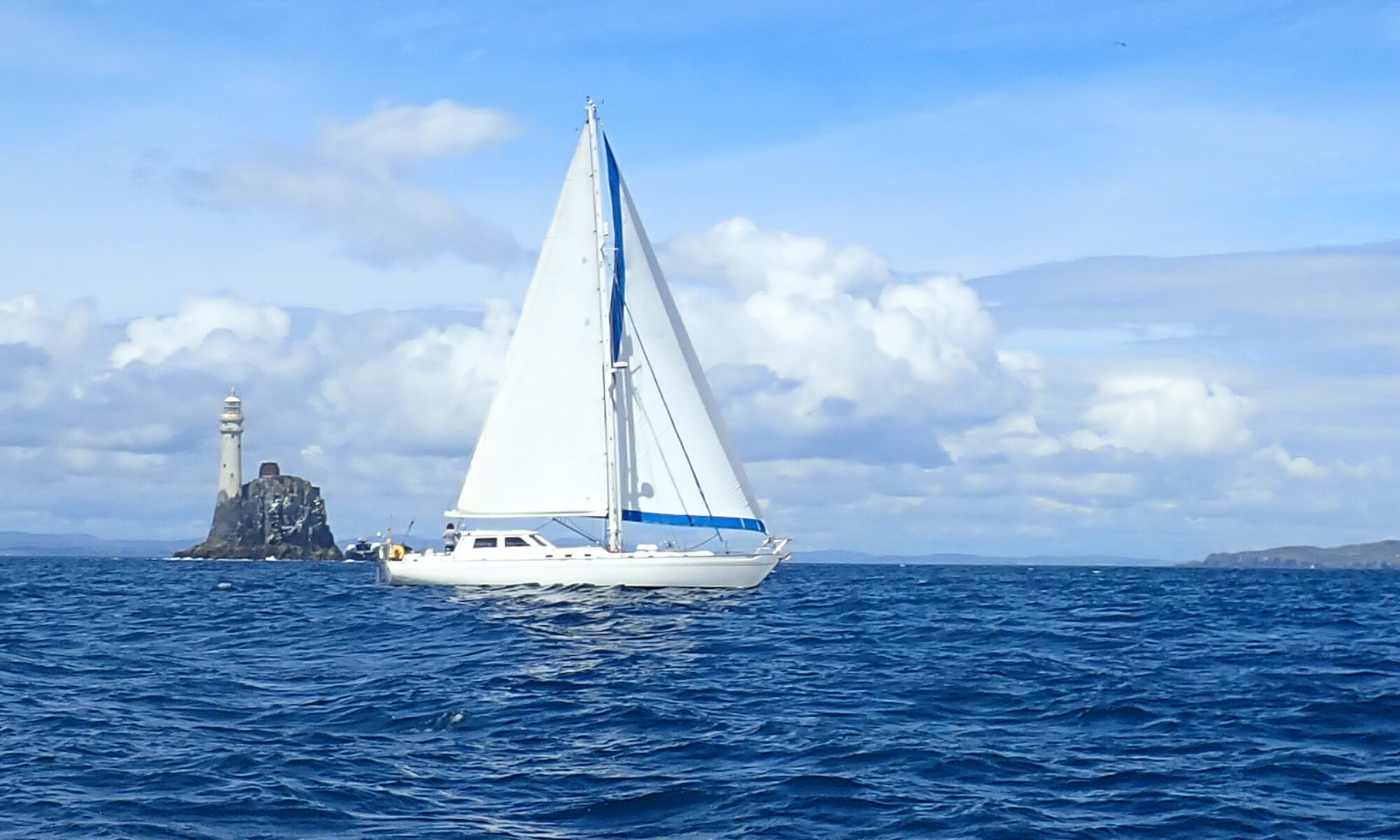
The next morning we had to motor through a narrow passage in the reef and out in to the open ocean which was rougher than the day before, but we had the same wind conditions and a great sail all the way to Savusavu. The last 5 miles were flat seas again as we entered the protection of the reef and we whisked along at 7 to 8 knots. Our friends on Barbarella were anchored in the Cousteau resort just outside Savusavu and took these pictures of us on the way in. Thanks to them!

Circumnavigation of Vanua Levu was complete

Just as we arrived at Savusavu, we got a message to say our parcels had been delivered and we picked up a mooring buoy and headed to the DHL office to collect our passports! All very easy, and a massive relief!

So here we are back in Savusavu as I write this. The weather is pretty awful at the moment, so we are pottering around and not doing much. Still haven’t decided where to go next!

Dom and Ailsa on Azimuth

Exploring Fiji

Hello from Azimuth to all of you and welcome to another instalment of the blog. Last time we left you, we had just arrived in Fiji after a slight navigational error left us short of getting to Minerva Reef. This time, we will tell you in on what we have been up to in Fiji.

We spent sometime recovering from the long trip from New Zealand and taking it easy. After going through the check-in process with the various departments of customs, immigration, health and biosecurity, we still had more paperwork to deal with. Officially we were not allowed to leave Savusavu with the boat until we received our cruising permit and this we were told could take a couple of working days. We took a trip to shore the next day to get the lay of the land, discover a bit of the town, pay a visit to the ATM for some Fijian Dollars and pay the numerous invoices for the health and biosecurity offices. That dealt with we adjourned for lunch at the Captains Table in the Copra Shed marina whom were renting us our mooring. A very nice place as it turns out, complete with the ‘Yacht Club’, a delightful little bar next to the waterfront!

We pottered about for a few days, discovering that the cost of food in Fiji was very reasonable and the choice very good too, with many of products from New Zealand, and cheaper than New Zealand too! Now we wished we had just waited until we arrived here to stock up on the major items for the boat. Still it bodes well for when we need to stock up again to head to the more remote parts of the Pacific.

We had some jobs to do as well. We sent Ailsa up the mast to rethread the main halyard which I had cut back and re spliced a loop in the end. Ailsa hauled up a mousing line to the top of the mast with fishing weights attached and threaded in through the main halyard sheave and fed it in the mast, then she dropped down and managed to fish it out of the small hole where the halyard exits the mast again. I was chief winch grinder for the whole operation, hoisting her up and down. We then pulled the mousing line through, attached the halyard and pulled it back through the mast. Tick, one job done!

The other major job was the repair of the autopilot, and that had me foxed for a bit. I didn’t want to start dismantling things until I had a better idea of what was wrong, so I fired an email off the manufacturer for some advice, after asking AI what was wrong. (AI was singularly unhelpful in this case!) In the end, an answer came back a week later. They diagnosed the problem as being the motor brushes. In my wisdom, when I bought the autopilot in Colombia, I also bought several spare parts too, one of which was a set of motor brushes. I spent half a day dismantling the motor, and low and behold, the brushes did look very worn, right down to the end of the springs. I cleaned out the dust, installed the new brushes and bloody hell the thing works again! I was a very happy chappy.

We only had 9 months left on our passports, and since we want to head far in to the very remote parts of the Pacific, we needed to get some replacement passports while we had time here in Fiji. Now to get a new UK passport, we have to return the old passports. Now this felt very WRONG! Effectively here we are in the back end of Fiji and we have to willingly surrender our passports? We were both very nervous about the idea. Still we completed the online applications and was given an address to send them too. We headed down to the local DHL office, a tin shed on the water front with our precious passports wrapped up in an envelope and asked if we could send them back to the UK. A lovely guy told us no problem! He then started the process, filing out the details on his computer. He took ages, with me repeating the details several times, eventually coming round the counter and helping him fill in the form and very carefully checking the details! We got there though, paid our 100 or so dollars and left him in care of our precious passports. It felt wrong!

He gave me print out with the DHL tracking number, and every day after that i was checking the website to see if our passports were on there way. For some reason the tracking status did not change for the next 5 days! All it said was, that the package was waiting to be collected? I was about to head to the office to find out what was going on, when the status finally changed, our passports had departed Fiji and were on the way to Sydney! Phew! We both breathed a sigh of relief. It took another week or so to get to the passport office and we had confirmation they were received. Our new passports have been issued and are sitting at Judith’s house (Ailsa’s Mum). All we need is for them to deliver the old passports back (which we still need) and then we can arrange for DHL to collect and hold our breath whilst they deliver them back to the tin shed in Savusavu … watch this space!

To take our minds off the passports, we decided to take the walk out of town and go and visit the local chocolate factory, a small cocoa plantation in the hills around Savusavu. We had a fascinating afternoon having the tour of the plantation and the small operation where they process the cocoa beans and then the all important sampling session and of course the parting off money to purchase several bars! We met the owner too, a very interesting chap called Richard who was originally from the UK and had led a very well travelled life all round the globe and ended up in Fiji. The plantation was his retirement project.

We made some new friends in Savusavu too, and as it happens ran in to some old friends as well. We originally met Ken and Caroline on their catamaran Water Music all the way back in Tobago Cays in St Vincent and the Grenadines and we had spent a week cruising together back in Grenada before we parted ways, so it was a lovely surprise when they popped up on our No Foreign Land cruising app as having also arrived in Savusavu. They came over to Azimuth for a cuppa and we arranged to meet that evening for a few drinks and a catch up at the Yacht Club. Ailsa knew she had met her match at the bar when she ordered the first round consisting of a couple of beers for Ken and I and two glasses of wine for her and Caroline. Caroline immediately interjected and said her fine British accent, “darling don’t you think we should buy a bottle of wine?!” Well, it was a fantastically fun evening, trading stories from our travels since we left each other in the Caribbean. I think the wine bottle tally hit 3 for the evening and we had to pour Caroline and Ailsa in to the dinghies to return back to the boats!

The invited us to their boat in the marina the next night and we talked well in to the night again. Ailsa and I were both exhausted and we cant keep up with these two Septuagenarians, they are hardcore!

In the meantime, we had managed to get our cruising permit from the customs office, they were like all the other officials, very amiable and easy to deal with as long as you are happy to wait.

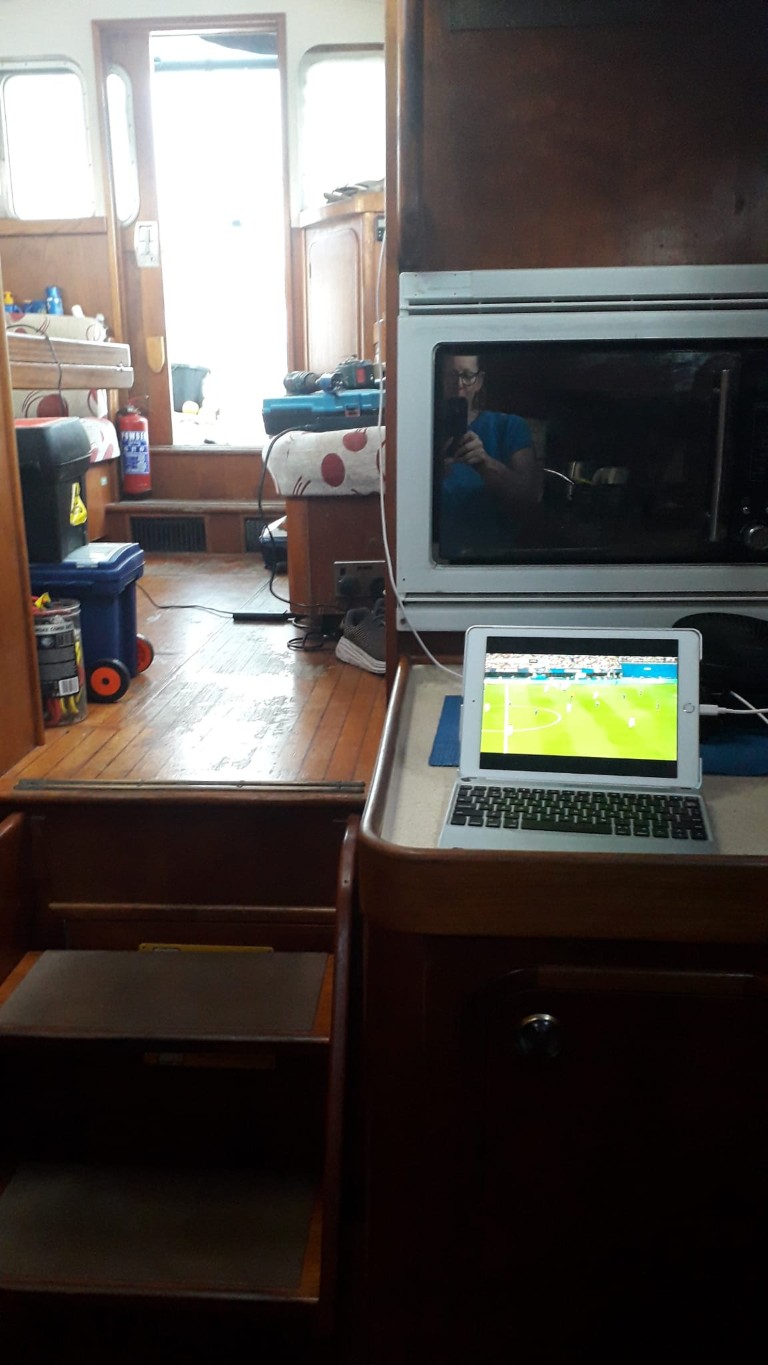
We had a few more meals out in town and stocked up on a few veggies. We wanted to head out and go cruising for a few weeks and plan to head back to Savusavu to collect our passports when we get that sorted. Ailsa spent a good deal of time watching World Cup Matches too!

As it turned out, Ken and Caroline didn’t have long left in Fiji and were due to park up the boat and head back to the UK in a few days, so we headed out for one last night together anchored only 4 miles from Savusavu off the beach from the Cousteau resort. Ken and Caroline eventually headed off in the other direction to us the next morning after we helped them extract their chain from a coral bommie! Hopefully we will see them again someday, we do hope so, they are such fun. They plan to head to Australia eventually where they will hang up the sailing shoes and sell Water Music.

Soon after they left we got boarded by the Fijian Navy! They were in the area and wanted to check all the paperwork on the boat. Two blokes and a young woman came on board to come and check the boat whilst a large rib moored up to Azimuth full of mean looking Navy men! As it turned out, again, they were very amiable. I handed the officer all the paperwork we had, and thankfully it was all in order. Then he asked to see our passports! Uh oh! In all the time we have been travelling across this planet by boat, the only time we have ever had to show our passports has been when we either check-in or check-out of a country. Now here we are without our passports and this Navy guy wants to see them! Well, I explained that we no longer had them and we were applying for new ones. He didn’t seem to mind especially as I had copies of them on my computer. We got away with it!

After a couple of days wait, the wind swung round a little and allowed us to head off from this anchorage further east along the coast of Viani Levu, the North Fijian Island where Savusavu resides. We had a lovely sail along the coast arriving in Vianu Bay in the late afternoon. Vianu Bay is huge and very deep with coral all round the edge. We didn’t want to snag a coral bommie so we dropped in 25 metres of water in a dark blue patch on the satellite image. Turned out we were quite near coral though! As we pulled back on 75m of chain, I checked the depth at the back of Azimuth and it was only 5m! We didn’t like that, so ended up moving again further out in the bay. These deep anchorages seem to be the theme around here. The shore shelves steeply and is mostly coral.

We had a couple of days in Vianu, but it was windy and a swell rolled in to the bay. The forecast weas for really strong winds, so we decided to move round the corner to another bay called Dakuniba Bay to ride out the blow. We pulled up the anchor, but the windlass did not sound right? About 15metres from the anchor it seized up!!! Oh no, not again! I found myself, yet again winding in the anchor by hand!

So I was not happy (that’s an understatement!) as we motored through a very narrow passage in the reef, with Ailsa at the front of the boat shouting if she saw shallow spots.

Eventually we got to a beautiful bay surrounded by mangroves with some small dwellings on the shore behind a small beach.

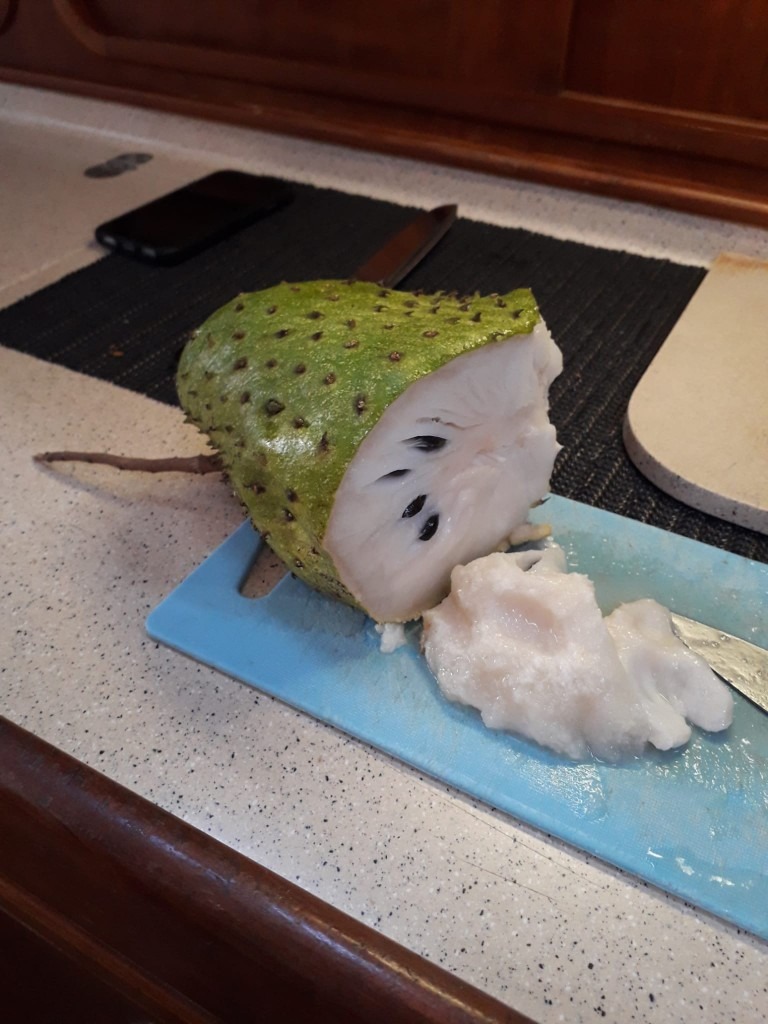
Not long after we arrived a older Fijian guy pottered up in his longboat with a huge sack of grapefruit he had had his nephew pick off the tree in his garden. His name was David, and this was to be the start of a lovely friendship over the next week. David and his family own 800 acres of land in this bay and run a simple farm. He was incredibly generous to us, bringing us the grapefruits, a huge bunch of banana’s, eggs, papaya, lemons, soursop, and other things! We gave him some Kava root that we had onboard to give to local people, that is prized. They use it to produce a drink that I had once in Tonga when we visited there. It has a peppery taste that numbs your mouth and if you drink enough is a bit like the effects of alcohol. I also gave David all the petrol we had onboard, about 10 litres for his outboard.

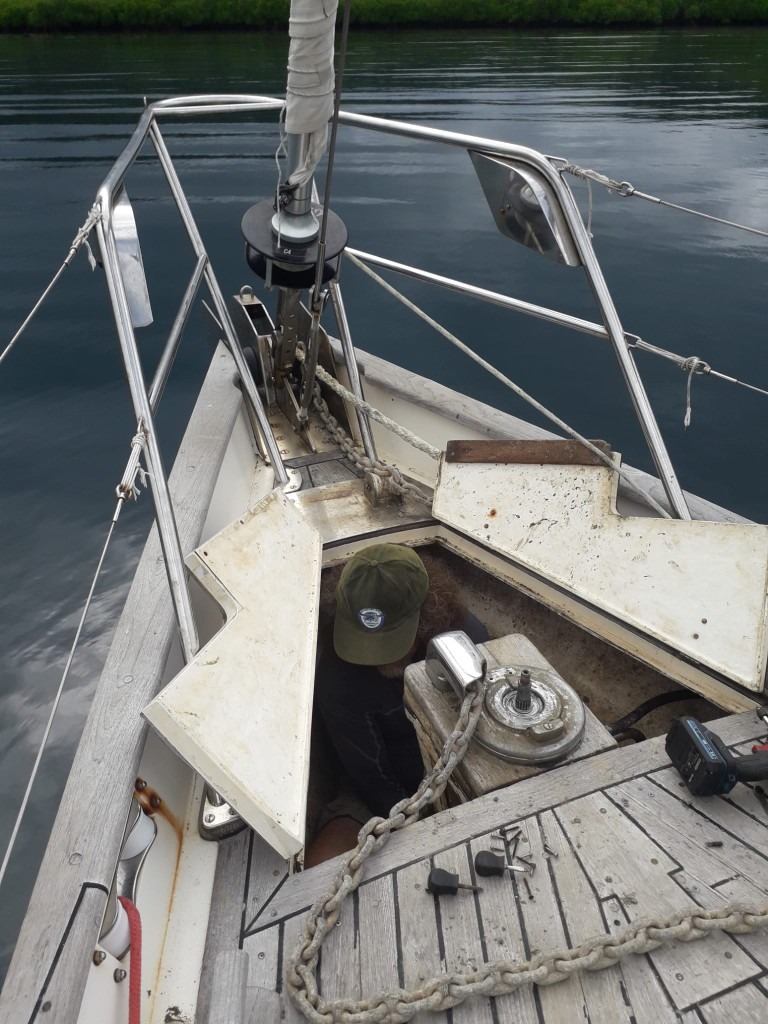
The first 4 days of being in this anchorage were taken up (for me anyway) stripping down the windlass to try and work out why it had seized up? I assumed that the gearbox had leaked oil. It was hard going. My boxing in job of the windlass had been thorough, but I had neglected to use stainless screws for some of the fittings and so they had rusted away in only 18 months. That took a day and I managed to get the hydraulic motor off without too much difficulty. The next 2 days were taken up with me swearing at the gearbox which refused to budge! Ailsa joined me on the 4th day to help but after a few hours it seemed hopeless. I couldn’t get the gearbox off, and therefore I couldn’t check if it had any oil in it. I admit I became somewhat despondent after that. Both Ailsa and David tried to cheer me up and a couple of beers helped a little. That night just as I got in to bed, the solution came to me. Because of where the gearbox is situated, I couldn’t get access to the oil fill hole ( and its at the bottom of the gearbox anyway, so pretty useless!) I decided to drill my own oil fill hole in the side of the gearbox case!

The next day I did just that, careful not to let any metal shavings fall inside the gearbox, i drilled a small hole and tapped it at M8, then used a short M8 bolt with Teflon tape to seal it as the fill cap. I pumped gearbox oil in to the box (it didn’t take a huge amount to fill it) and then put the whole thing back together. When I fired up the windlass, the gearbox ran nice and smooth again…. fingers crossed this is a permanent fix? (or have i just jinxed it again?!) So far so good.

One day I took a trip in to the mangroves along a couple of small rivers (see video below) and I met up with David. He took me to go and feed the pigs on his farm. They had all escaped from their makeshift pen in the coconut palms when we arrived, but David had them running, and they all clambered to get back in their pen. I realised why as I watched him chop up coconuts that we had been collecting on the way with an axe and throw them in to the pigs. They all went crazy and started fighting each other to get the coconut flesh! I also met David’s brother and other family members up at the farm. Such a beautiful place.

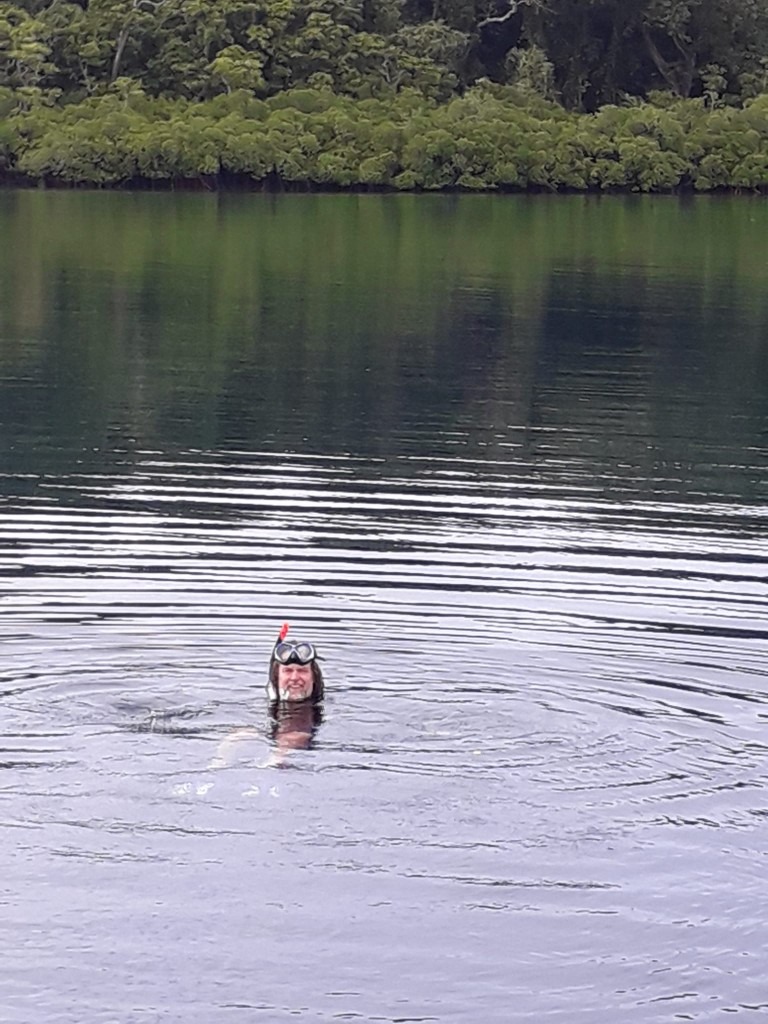
On another trip, Ailsa and I took the dinghy out and went to snorkel off a beach outside of the bay in the channel inside the reef. It was great fun. You shall see an amusing scene on the video below if you watch it!

After a week then, the wind dropped, and we said our goodbyes to David, promising to come back and see him again. And now we headed off with plans to circumnavigate Vianu Levu back to Savusavu.

It was pretty windy when we left the protection of the South coast of the island and got hit by the trade winds. We sailed up through a narrow passage between the main island and the island of Kioa, and arrived at another beautiful anchorage in a bay with mangroves. We spent a couple of days relaxing, no more boat jobs pending! I took the canoe out to explore and did plenty of snorkelling too. The reef here was very healthy and the bay was full of bright blue starfish.

Another short sail took us further North to Rabi Island and the pretty anchorage of St Katherine. To get there, we had to cross the international dateline again, the charts and satellite images are terrible! Very lots of mark one eyeball and reliance on depth sounders!

Rabi is occupied by the Banaban Indians. They have an interesting story to tell, one where we didn’t feel proud to be British:

The Banaban people are the indigenous inhabitants of Banaba Island (in Kiribati), with a rich cultural heritage disrupted by colonial phosphate mining and forced relocation to Rabi Island, Fiji.

In 1900, the British annexed Banaba and leased the island to the Pacific Islands Company for phosphate mining under a 999-year agreement, providing minimal compensation to the Banabans. The British Phosphate Commission (BPC) oversaw extensive mining operations, which removed nearly all of the island’s surface, leaving it environmentally devastated and largely uninhabitable. The Banabans received less than 0.1% of the profits generated from phosphate used in global agriculture, highlighting the economic exploitation they endured.

During World War II, the Japanese invasion prompted the relocation of Banabans to other islands, and eventually to Rabi Island in Fiji in 1945. Upon arrival, they faced unfamiliar conditions, including a lack of housing and infrastructure, and had to rebuild their community from scratch. Despite these hardships, the Banabans maintained their cultural practices, language, and social structures, ensuring the continuity of their identity

We read about this before we took a trip to shore. We were met by some incredibly friendly people, and took a stroll round the town followed everywhere by a herd of children, picked up some supplies at a little shop and headed back to buy some fish from the local fisherman’s commune on the shore.

We had already met the guy who ran this when we arrived in the dinghy. When we returned, he asked me if I could come and have a look, they had a problem with their solar panels and the freezer where they kept the catch of the day had stopped working? Of course I went to have a look, the inverter and batteries for the system was stuck in a little dark room in the corner of the shed, so I took a look. We bought some fish, and I took some photos of the equipment and promised I would come back in an hour or so when I got back to the boat and downloaded the manuals for the inverter to see if i could diagnose what was wrong .

So that’s what I did, I got some tools together and we went back to the shed. Well I stripped the unit down and cleaned some terminals and tinkered around for a couple of hours, but couldn’t find the problem. It was complaining that the DC input voltage was too high, but when I measured the voltage with my multi-meter it was fine, and didn’t match the voltage the display was saying. However, when I put it all back together again and switched it on, it worked! That left the fisherman very happy, because the freezer came back on, and the fish were saved.

I promised I would email the company and find out what the problem had been and how to fix it which I did when we got back to the boat. They replied the next day and we went back to the fishing commune to tell them what the company had said. Basically they gave a list of issues it could be, but thankfully the system was still working okay the next day. The fisherman were still very happy. I gave them a contact for the inverter distributor in Fiji in case they had a problem again. They gave us a big bunch of banana’s to say thankyou and joked that I had magic fingers to have fixed the problem. I still don’t know how I fixed it?! But I was happy to have helped them out. They are miles from anywhere, very remote even for Fiji. Hopefully it continues to work! I think we have made some solid friends on Rabi Island!

After a couple of days, we started the journey North again. A really surprising sail along the windward side of Rabi Island had us hard over on a beam reach doing 9 knots but on a perfectly flat sea and then we worked our way through another reef channel using the satellite map and dropped the hook off a beach with a busy village at the back called Albert Cove. We didn’t stay that long, we were getting woken up every morning at 5am by kids on the beach practising recorders?!

Since then we stayed the night in a windy anchorage off a small island called Trilagica Island off the North Side of Vianu Levu.

The sailing has been magical as the North side is the windward side and we have had 25 knots of wind on a broad reach but with flat seas. Azimuth has been whisking along at about 8 to 9 knots.

So here we are now as I write this sitting off another beach on the North side of Vianu Levu in a beautiful bay called Blackjack Bay, we have had a couple visitors from local people who live around the area as we seem to be on a transit route to a local small shop about 3 miles up the river from us. Everyone is super friendly!

I will leave you now. When I started writing this, I thought I didn;t have very much to say, but it turns out we have actually been quite busy!

Here’s a video that gives you a flavour of some of the places we have visited. Join us next time as we explore more of this fabulous country.

Dom and Ailsa on Azimuth.

We Need to Swerva to get to Minerva.

Hi to everyone and welcome to a new update of the Sailing Azimuth blog. In the last blog, we had just arrived back in the Bay of Islands in North New Zealand, completing our circumnavigation of the North Island. So lets get in to what has happened since then, and how I am now writing to you from the lush tropical paradise of Fiji!

I know the title of this blog is a little cryptic, all will be revealed to those that read onwards, perhaps the alternative title for this blog could have been “The Long Wait”? Because for the entire month of May and for some of June too, that’s what we have been doing, waiting for the weather and an opportunity to sail North to Fiji. There were a good number of people with us waiting too. The Bay of Islands is arguably the best setoff point for this passage, given that it harbours the town of Opua, where you can check out of New Zealand when travelling by yacht.

So when we first arrived in the Bay of Islands, (from here on I will call it BOI), we headed for the North of the Bay and anchored ourselves in a river estuary a couple of miles outside the town of Keri Keri. One of the main things on the to-do list was to buy an outboard engine for the tender, which we had been without for our entire time sailing around New Zealand. Azimuth’s tender is like her car, its what we use to get everywhere from anchor, and for that entire time we had been oar powered! Great for physical fitness, but somewhat restrictive when it came to going any distance further than a mile, and several times, we found it impossible to leave Azimuth even if we wanted to, when the wind got to the range of 20 knots or higher. You could row, and find yourself going backwards!

Kerikeri is the address for the electric boat company, and I had my eye on a new electric outboard made by a company called Epropulsion. It was a good price too, since in New Zealand, foreign flagged vessels don’t pay VAT (called GST here) on boat parts, which is a very generous arrangement. We dropped the hook and I contacted the company to get my hands on one. It took a week, since it had to come from Auckland.

We had been anchored for a couple of days in the pretty estuary, but we had been under attack by the nearby seagull population which had now adopted Azimuth as a night time roost. We were literally covered in them, and their deposits! We decided to move round the corner to the equally pretty Onion and Napua Bays to wait for the outboard to arrive. These were thankfully seagull free and we spent a very pleasant week relaxing.

You get a flavour of Napua Bay in this silly video of me just rowing round it one Sunday morning. Listening to the birds, and enjoying the views.

Eventually Chris, from the Electric Boat Company got in touch to let me know when our new outboard was ready to collect, so we pulled up the anchor and headed back to the Kerikeri inlet, this time taking Azimuth in as far as we dared up this shallow estuary at low tide. I needed to row the dinghy up the river to go to the Chris’s dock, so I set off mid afternoon with the rising tide. it took me about an hour to row, I got stuck once when I tried to take a shortcut across a corner, but I made it. Chris was a lovely bloke and we had a chinwag before I fitted the new electric engine and set off back to Azimuth, arriving in the gloom just after sunset to the relief of Ailsa who was waiting anxiously for me.

I have to say, so far, I have been very happy with our new car engine. Its so easy to use, and its so quiet! We have shocked a few people who never heard us coming, rather like an electric car! Admittedly, we wont be breaking any speed records, but I will trade speed for peace and tranquillity and lack of maintenance any day … maybe I’m getting old?!

So, with that sorted, the next day we headed towards the little town of Russell where we hoped to pick up some needed supplies to supplement our dwindling vegetable stocks and then think about what to do next, we supposed, sit and wait, and look at weather models?

On the way to Russell, the weather gave us this amazing rainbow as entertainment:

Well it turns out quite a few boats had the same idea. Russell is a very agreeable little town and offers many temptations including restaurants, pubs, supermarkets and cafes with a very laid back atmosphere. It being the beginning of winter too, it was free of the usual crowds of tourists and most of the transient population of the town now seemed to be cruisers like us. Their boats at anchor, seeking out things to do for the long wait for weather. The “Hell Hole” café seemed to be the place to congregate for elevenses, where you could always find some fellow cruisers and the start of the conversation would always be something along the lines of, “So, have you seen a weather window yet to get to Fiji?”

We anchored off the Russell Boat club, a little yacht club with a handy pontoon to leave your dinghy. We made a couple of visits to the club in the evening too where we were warmly welcomed by the locals and the beer and wine flowed easily.

As well as waiting for the big weather gods to align the wind and waves for the passage to Fiji, we had to keep an eye on the local weather gods plans to spoil the fun too. After all, it was now winter in NZ, and we had plenty of low weather systems hitting North Island. We had to retreat from Russell for one of those and ride out a gale at anchor about 8 miles round the corner in Opunga Cove. The motor there before the blow was beautiful.

After the blow left, we headed back to Russell to continue the wait. Not before I had to untangle this mass of fishing line from the anchor chain!

This constant waiting was a little wearing. Eventually, in early June, a passage window started to form. The weather models predicted a large high pressure system that could whisk us all up to Fiji with an option to stop at the intriguing Minerva Reef where is is possible to anchor in what feels like the middle of the Pacific Ocean. Minerva Reef is barely above sea level, and is almost completely covered at high tide, but its inner lagoon offers a Haven for yachties to anchor and enjoy the fabulous snorkelling and marine life. We missed this place on way down from Tonga to New Zealand a couple of years ago, because we didn’t have a functioning anchor windlass. So this time it was on the wish list.

So, the weather gods did start to align. The chatter about the weather amongst the cruisers got more and more intense with the debate fierce. We got to the point of deciding this was the opportunity, going as far as to book our exit interview with customs (you have to give them 48 hours notice), and then the debate subject became, who was leaving when and at what time?! We have never known such an intense build up to a passage, we have always just decided on our own and not really been involved in such an intense Chinese whispers situation.

Once the date was set, the intensity continued to rise. We now moved Azimuth round to anchor in Opua off the marina, ready for the exit interview, but wait a minute, what’s this strange change in the weather prediction? A small low predicted to form a week out over Minerva reef? We watched, the models updated every 6 hours, the predicted low got bigger and bigger… at the last minute, the uncertainty was too high! Now the cruiser debate hit fever pitch! We watched and debated ourselves, and the morning of the day we were to leave, I looked again at the weather models, and I didn’t like what I saw. We cancelled!

I think the downpour and horrible weather in Opua the day before was an omen..

It was exhausting! Most other people also cancelled, but some brave souls did set out, arguably to their regret when they were faced with large waves and strong winds.

With the decision made, we took the opportunity to fuel up Azimuth at the marina and headed back to Russell for the next round of waiting. Oh and there was a certain person onboard who needed to celebrate some kind of annual event…

We headed that evening to the Duke of Marlborough pub in Russell for some of the best food we have ever had in New Zealand, washed down with beer and wine, and then were joined by some cruiser friends to make the most of the evening! It was a great night and an opportunity to unwind all that pressure. Both Ailsa and I did not feel too good the next day!

Lo and behold, the long range forecast was offering another passage opportunity in a week or so’s time, but I couldn’t put myself through the build up again, so with the weather looking amazing for the following week, I convinced Ailsa that we should head away from Russell and go for the walk to Brett Cape lighthouse out at the entrance to the BOI. We did not regret this choice, it was awesome!

The sail out there was slow and calm and we dropped the hook in a place called deep water cove about 5 miles from the cape. The water was crystal clear and we had the place to ourselves, with all the peace and tranquillity we could could desire.

The next day we took the dinghy to the stony beach at the end of the cove, and with water bottles full and lunch packed we set off under a cloudless sky along the track to the lighthouse. It was a tough climb from the start and we both wheezed up the hill, realising that it had been at least a month or so since we had done anything strenuous. The reward after the first hour were breath taking views of the Cape and the jagged peaks with dizzying drops down steep cliffs.

The birds sang, and many hopped along the path in front of us leading the way. We saw no one else on the trail, we had it to ourselves. This was a cruel path though, up and down steep gradients, but with many rewards of stunning views. The lighthouse itself must have been hellishly difficult to build due to its remoteness, but stood looking over the spectacular cape. The path leading to the last 500 metres to the lighthouse took you along a razors edge ridge with steep drops on either side and was the most spectacular section. Here’s a video that captures the highlights, starting at the lighthouse and working back to Azimuth. This walk definitely finds its way in to my top 5 of NZ walks.

We both slept well that night! And a couple more days of being sat at anchor in this wonderful place reminded us of why we do this.

The cruisers WhatsApp group for the passage to Fiji continued to chirp away in the background, but we took our own time to assess the next weather window, and this time it looked good. So, we booked another exit interview and headed back to Russell for one last shopping expedition for supplies. We met cruiser friends again, but this time it seemed more straight forward, the weather looked easy and the choice was much more obvious that last time. Again we headed to Opua, and this time, there were no surprises. The next morning, the weather model still looked good, this time we were going! The exit interview was very straight forward, but we felt sad to be leaving NZ, it felt like leaving an old friend.

Nevertheless, leave we must, and pulling up the hook, we motored out of Opua with no wind. An hour later we had passed Russell in to the outer BOI and a breeze started to build for a slow sail on flat seas along with about 10 other boats that we could see, probably many more that we couldn’t all heading for Fiji or Minerva.

I still had my New Zealand charts loaded on my chart plotter and I typed in the Waypoint to Minerva Reef I had written down earlier in my logbook. The way point was off the edge of the visible chart, and I didn’t think anything off it ( a clue as to what was to come later?)

The winds got a little stronger but were on a dead run behind us, and we goose winged the jib and full main and comfortably sailed without too much rolling. As time went by after a couple of days, the wind shifted enough for a broad reach and now we clipped along at a good pace. On the third night out, about 10pm in pitch black, we were still clipping along, when I heard a bang, and the sound of the main sail falling down! I switched on the deck lights and lo and behold, the halyard had snapped and the mainsail was heaped on the boom. Bugger! Now the balance that was afforded by the mainsail was gone, and we were rolling horribly. But it was the middle of the night, and I wasn’t about to try and fix this in the dark so we lolled around all night, sailing with just the head sail until the next morning.

It took a few hours and I felt rather green by the end of it, but I managed to remove the topping lift at the end of the boom and repurpose it as the main halyard, climbing up the foot of the mast in the rolling seas to attach it to the mainsail. This topping lift rope is not a strong as the main halyard so I only put two reefs in the main and reduced the tension on the rope. Still, we were back sailing again, and the rolling stopped. In the back of my mind, I thought, this is the problem for the trip sorted, it will be plain sailing from here.

And the sailing was good! We kept up a good speed on course for Minerva Reef with a great wind angle which was now a broad reach. I came on watch early that morning and thought, okay, its about time I change the chart over on the chart plotter to our Pacific Islands chart so that we can see Minerva. I duly changed the little SD cards over and rebooted the plotter. I zoomed in on our way point and was instantly confused? There was no sign of Minerva Reef on the chart at the waypoint? I opened my laptop to look on my charts there and typed in the waypoint. Same again, there was no Minerva reef? What? What’s going on here? I got our “World Cruising Routes” book out from where I had taken the waypoint from in the first place and compared it to that I had written down in my logbook? Now my error became clear! I had written the letter E (for East) after the Longitude, when I should have written W (for west)! Minerva Reef was actually the other side of the International Date Line! Oh bugger, was what I thought, (actually it was a much stronger word, repeated several times). I corrected the waypoint and zoomed in to see Minerva Reef exactly where it was supposed to be. We were heading 60 miles to the east of it!
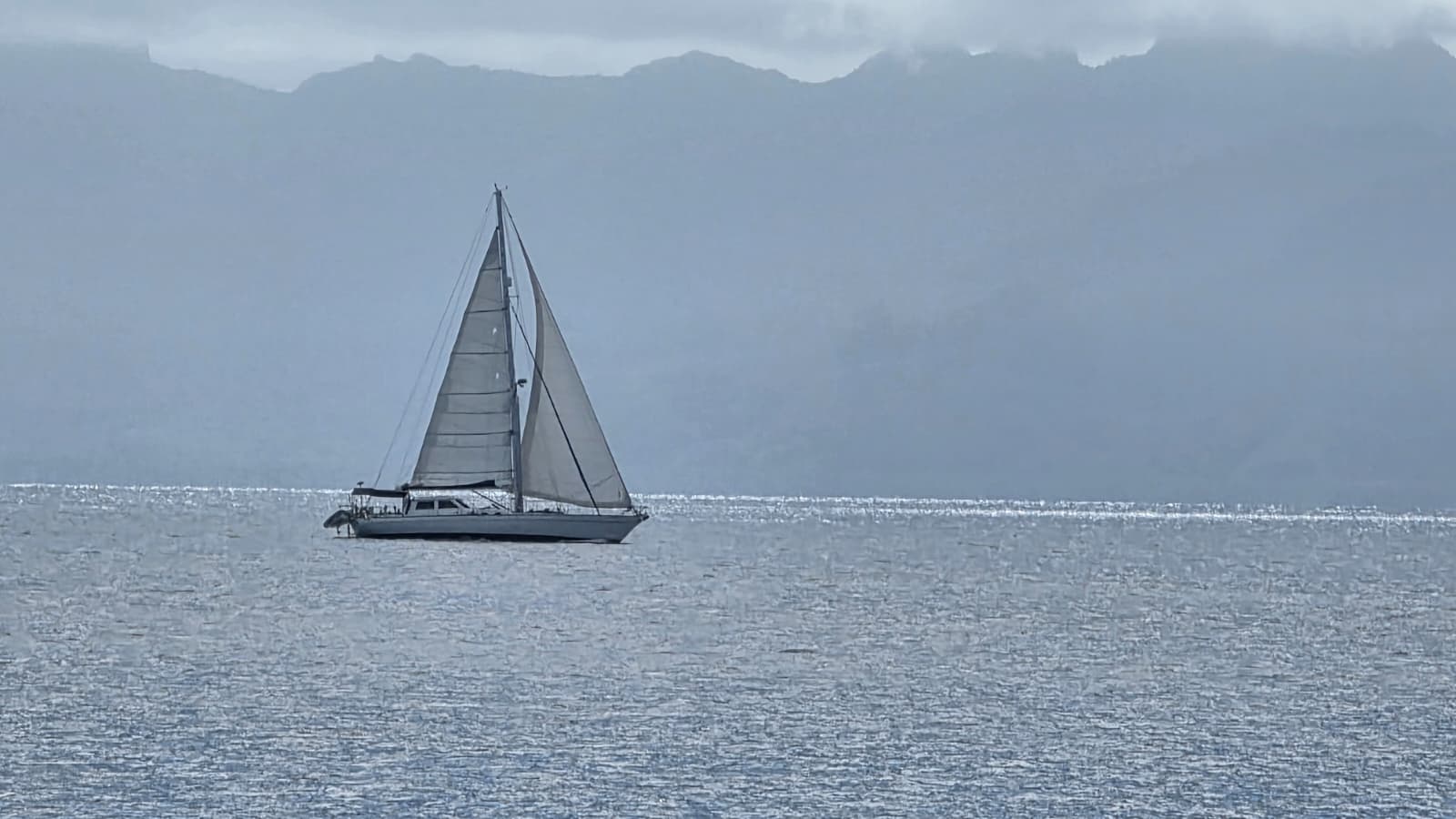
Once I had calmed down and kicked myself for my stupidity of sailing in the wrong direction for the last 5 days, I thought okay, lets change course. Well that was not so easy, now instead of a nice comfortable beam reach, it was an upwind sail, about 45 degrees apparent with frequent changes to 35 degrees apparent. I fought for 5 or 6 hours on a beat whilst Ailsa slept in blissful ignorance, but Azimuth was not happy, slowing down to a crawl, and bashing in to waves, and it was not comfortable sailing. Of course the distance had changed too, we now had 190 miles to go. Eventually I made the decision to give up and just head to Fiji instead, now 350 miles away but on a nice broad reach the whole way.

Now you understand the title of the blog? It came to me that morning when Ailsa got up to take over and I explained what had happened. Again, a visit to Minerva was not to be!

My ego was somewhat bruised for the rest of the day, and we had some other news from home that was not pleasant too. I eventually picked myself up and got on with the business of getting to Fiji and the port of Savusavu.

It got quite squally, but the wind only ever got to 32 knots, and on a beam reach we were clipping along nicely. The drama unfortunately was far from over. Later that night, Ailsa experienced our first “No Rudder Response” alarm from our autopilot system, the system that drives the boat for us on a set course. When this alarm happens, the pilot disengages, and you have to manually restart it. You need to do this fast, or the boat can go wildly off course, especially when the wind is strong, since nothing is controlling the rudder. This is not entirely unusual, it happens if the system has to work really hard when, for example, we are surfing down a large wave. I thought nothing of it. However, shortly after coming on watch, I had another alarm. Over the next few hours the alarms got more and more frequent. Until the alarm was every few minutes or so, keeping me on my toes all night.

In the morning, when Ailsa got up, we decided to try and take a look. I suspected there may be a loose connection somewhere, so Ailsa steered by hand whilst I emptied the lazerette locker and climbed in to the hell hole under the cockpit to take a look. I checked all the connections, but they all looked good. However, the autopilot seemed to work again? I thought okay, maybe I fixed it?

This smug feeling was only to last a few hours and then the alarms started again! I tried a couple more times to check connections and voltages, but the problem continued eventually getting to the point that the autopilot would not start at all without immediately alarming. Bugger…. we had no choice but to hand steer Azimuth all the way to Fiji, 250 miles to go.

So that was life for the next two days, 2 hour shifts, 24 hours a day. The first 24 hours were tough with 25 knot winds and surfing down large waves, The second 24 hours were more pleasant as we got in to the protection of the Fijian Islands.

We were both happy to see the Northern Island of Fiji come in to view on the final morning. We were both exhausted and snapping at each other, we had both had enough! A visit by a pod of dolphins to welcome us to Fiji bought some comfort. The relief was palpable as we picked up a mooring buoy in the pretty little port of Savusavu. We somehow managed to get through the visits to Azimuth by 5 officials from customs, health and biosecurity before pretty much collapsing in to bed at 7pm that night and sleeping for 12 hours! All in all an “interesting” passage. I may have been heard to say a few times, “lets sell the boat and buy a camper van instead!”

Here’s a little video I put together of the trip…

So here we are, sitting in Fiji. And it is wonderful. But you will have to wait for the next instalment of the blog for the details.

Dom and Ailsa on Azimuth.