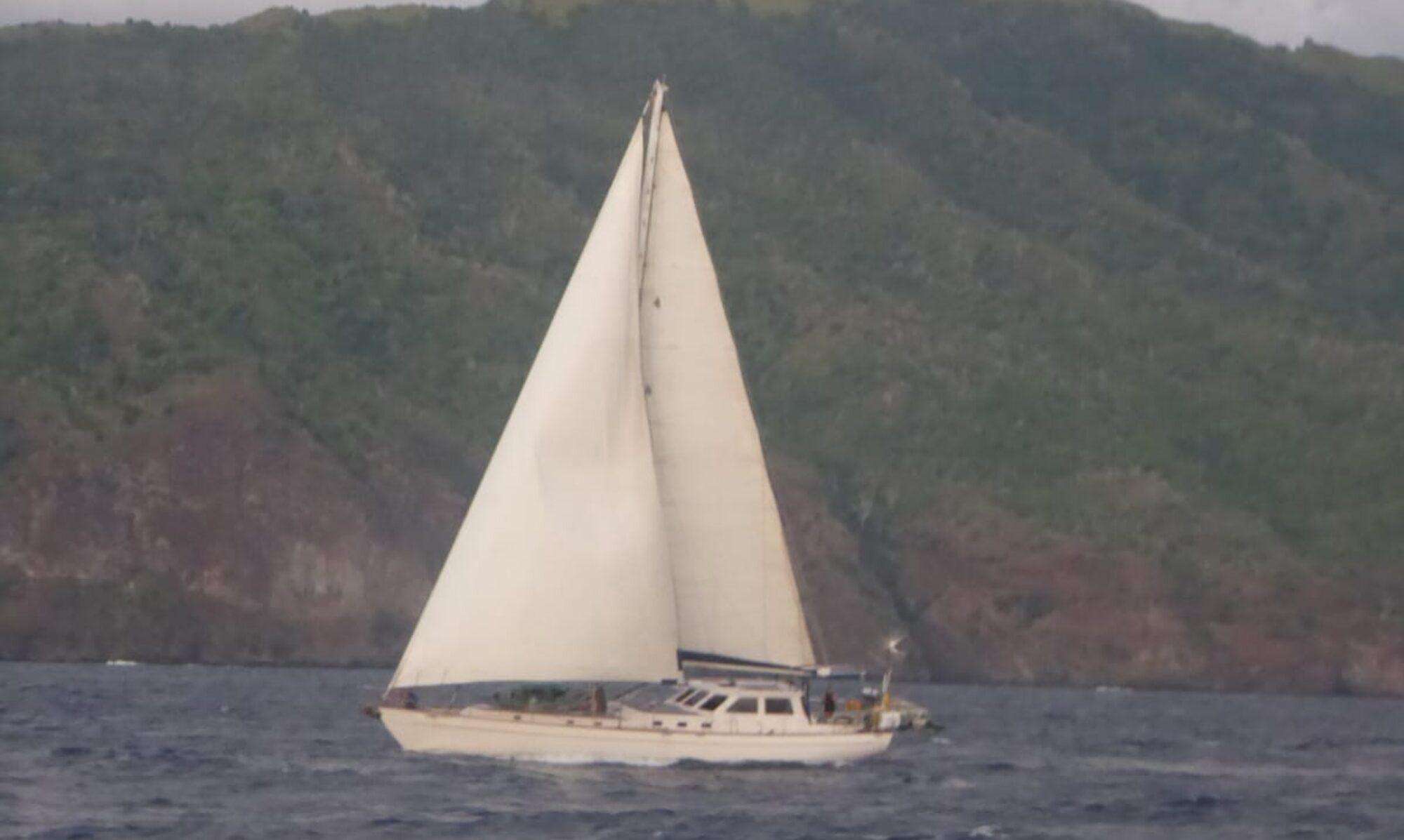


Hi to everyone, and welcome back for another instalment of the adventures of Azimuth! Last time we left you we had arrived in the Bay of Plenty on the East Coast of New Zealand the vibrant Port of Tauranga. This time we will tell you about the highs and lows of our sail down the formidable East Coast of New Zealand, our side trip to the City of Wellington, and then crossing the mighty Cook Strait to enter the Queen Charlotte Sound where we are currently cruising around.
Now it turns out sailing down the East Coast of New Zealand is no walk in the park. Its of course open to the Pacific with nothing between it and the coast of South America but ocean. Its rugged and has very few options to stop anywhere. At the bottom of the East coast in the Cook Strait, a tortured piece of water that is about 20 miles wide (think Dover to Calais) between North and South Island, with mountains on either side, all acting like a giant wind tunnel, and where the Pacific tides meet with those of the Tasman Sea. And as we were finding out, the weather in New Zealand does not remain in one state for long. Just as your thinking, ah this is lovely settled weather, in rolls a huge depression bringing rain and gale force winds and turning the Cook Strait in to a maelstrom!
So I was a little nervous about this passage. Its only 440 miles, which in the grand scheme of sails that we have under our belt is a mere trifle, but we hadn’t done a sail of any significant length for over a year, and well, coastal sailing can come with its own set of unique challenges.
Newly arrived in Tauranga then, I imagined we would be there a while waiting for a good weather window. Within only a day, the wind charts started to align. To the south of us in the Tasman Sea, a large low pressure system was heading for the middle of South island, whilst we sat in High pressure, and all that air was being sucked South giving us a downwind sail down the East Coast, but we would have to be quick, because in 5 days time, another huge low developing to the North of us in the Tasman sea would move South East and hit the bottom of North Island. We needed to be tucked up safe before that happened! On paper it looked good as long as the forecast held.
The next day, the situation remained the same, and we decided to go for it, so we pulled up the anchor in Tauranga and set sail towards the East Cape. The sea conditions were a little rough as we sailed through the night past the volcanic White Island and avoiding the 2 mile exclusion zone around the volcanically active Volkner Rocks in the deepest dark of a moonless night. The wind died early the next morning and we were met by a glorious sunrise and the spectacular mountain scape of the Eastern Cape on New Zealand as we motored East.
By 9am we had reached a very beautiful anchorage called Hicks Bay, only 15 miles or so from the East Cape headland itself. We decided to stop the night here and recover from the first leg. Hot water (a luxury!) provided a nice shower and I relaxed a little, before checking the weather for the next leg. Things had changed slightly, the low due to hit in 4 days time, was now going to hit in 3 days instead! That didn’t give us much margin for safety, so we talked it through and made the decision after only an hours rest to up the anchor and set on our way!
The weather was glorious. Force 4 winds on the beam had us round the East Cape easily and set sail south. All was going well, until the wind died later that afternoon. The sea state died to nothing other than a mild Pacific swell, and being only 10 miles from a bay marked as an anchorage we turned on the engine and motored towards the shore. As the water gently shallowed, the swell grew and as we approached the rocky bay, we could see the spray in the air where the waves were pounding the rocks. It was clear that this was not going to be a viable safe anchorage! So examining the latest forecast I could see that in a few hours a breeze would develop 25 miles to our South and we motored in search of the elusive wind that appeared about 10pm that night. Only 8 to 10 knots, we turned off the engine and sailed through the night ghosting down the coast, but non the less making good progress.
The next morning as forecast, the wind increased, but ahead of us, the picture had changed and the weather around the entrance to the Cook Strait looked more threatening, however, the sailing was still good and we sailed south west. We finally reached Cape Turnagain, about 100 nautical miles from the South tip of North Island. This cape was named by Captain Cook, as they fought to head South and then gave up when they reached this point.


The wind actually completely died for us at this point and we had to motor for 40 minutes, but then it came back, and this time with vengeance! Over the next 12 hours the wind cycled from 8 knots up to 40 knots and back again every 30 minutes or so. It was very bizarre and nigh on impossible to sail as we had to reef hard and then let sail out again when the wind dropped. The sea state was horrendous and because we were trying to sail upwind at about 50 degrees apparent, often the toerail went right under water with the waves hitting our kitchen windows.


This carried on well in to the night, and when we finally passed Castle Point, we decided to relent as we could no longer sail in the right direction and motor sail the next step. Within a couple of hours we broke free of the gale and bizarrely found ourselves in flat seas and no wind! The sunrise was a welcome relief and we motored towards an anchorage at the bottom of the Cook strait near Cape Palliser where we could drop the hook for a few hours respite.

Why we were asleep, some divers stopped by in their rib and left us some shellfish on the deck. They came back later that day to check on us again, and we thanked them. They were concerned that we were staying the night in the anchorage, because in the next 24 hours, the wind was due to swing 180 degrees and then become storm force, blowing straight in to the bay we were anchored in! We told them we were just having a rest and then we were going to set off that night for the last leg through the Cook Strait and into Wellington Harbour to wait out the storm there.


So we had a 12 hour window before this low hit the bottom of North Island, and at 9pm we pulled up the anchor and headed off to Navigate the Cook Strait.


The first couple of hours we were motoring hard in to 25 knot headwinds and rough seas (not forecast at all) and then as we rounded Cape Pallisar which guards the entrance to the Cook Strait, the wind did swing behind as forecast and we had a smooth motor sail all the way to the entrance to Wellington Harbour. I had to slow Azimuth down in the end to wait for sunrise so I could navigate the entrance. Its narrow, there was a big swell behind us. There are large ships and ferries that have right of way in the main dredged channel as well as some nasty rocks and banks! Not an easy place to enter in the dark, especially as we had never been there before. it was a grey day that great us, cloudy, cold and wet, but we were both happy to beat the storm and get to a safe anchorage in Oriental Bay, right in the centre of Wellington.


I put this video together of our sail. Looking at this, it looks very laid back! We of course didn’t take any video of being in the gale!
I think I slept for the next 24 hours! I didn’t really even notice when that storm hit us a few hours later. It was a lovely anchorage, and we were amused by the number of people swimming off the beach in all conditions of wind and rain, and in freezing water. They are crazy the people in Wellington.
The wind decided to swing again 180 degrees 24 hours after the storm passed through and we had to move to another anchorage called Evans Bay. Although we were anchored not far from a dock and a local Yacht Bay, we were stuck on the boat for several days with strong Wellington Winds. Evans Bay was pretty though and eventually we did manage to get off.


The highlight of our time in Wellington was the chance to meet up with an old friend from Nottingham called Katy. She moved to NZ back in 2002, so we hadn’t seen her since we left. We met up with Katy and her partner, Brydon and had a lovely afternoon out at a local cafe and caught up on news and reminisced about old times! We also got the chance to meet them all again a few days later at their home. It was lovely to see them, and we hope they might get the chance to come and stay on the boat for a few days where we are now in the Marlborough Sounds.


One afternoon, Azimuth was used as a way marker for the local yacht club evening race!
We would spend over a week in Wellington (but not actually visit the centre!) and then the wind decided to final drop a little and swing 180 degrees again giving us an opportunity to cross the Cook Strait.
This would be the final sailing challenge before we finally reach South Island. Thankfully the royal yacht club website in Wellington had some very clear instructions on to how cross the Strait in terms of optimum timing. We would need to arrive at Sinclair Head outside of Wellington an hour before high tide to find slack water and then gain a favourable tide for the North Westerly crossing. The tide rips through the strait and its generally better to sail with wind and tide in the same direction. The reason to arrive at slack water is to avoid something called “The Rip” where the tidal stream is forced through the narrow section of the Strait! The forecast was for Force 4 winds, and sunshine.
It was murky when we motored out of the harbour in to strong head winds.


As we turned in to the Strait, we were able to sail on a close hold to Sinclair head about 6 miles ahead. It was quite rough and the winds were not too strong. We arrived at Sinclair Head as exactly as planned, at the same time as two other small boats doing the crossing. Slack tide? We sailed through here at 12.5 knots!!! with winds of 20 knots apparent. I would say at least 5 knots of tide with huge swell. We left those other boats for dead!


We headed out doing at least 10 knots all the way across, weaving between a cruise liner and a container ship. About half way across there was a loud crunch, and the autopilot alarm went off as the boat lost steering! Uh oh, I had to hand steer the rest of the passage. On the other side of the strait we had to negotiate the narrow entrance to the Tory Channel, a rock strewn narrows where all craft have to give a 10 minute warning of approach because there is barely any room for the huge Cook Strait ferries that use this channel to get to Picton. Thankfully, it was clear as well sailed through and the large waves died away to nothing as did the wind.


The tory channel is a stunning! Like a huge Norwegian fjord, flat seas surrounded by mountains. We dropped the hook in the a bay called Hitaua Bay and breathed another sigh of relief. It felt great to arrive in South Island!
An inspection the next day of the autopilot releveled the reason for the bang. The woodwork that I installed to hold the autopilot ram back in Colombia had destroyed itself, snapping a timber 4″x3″ and shearing two pieces of 18mm plywood! I guess it was under some load, probably weakened during that gale. On reflection, breaking when it did was no major issue, as it was only 3 hours or so of hand steering after that. Had it happened during the gale, it would have been much more difficult as we still had 100 miles to get Wellington!

So since we have arrived in Queen Charlotte life has been very relaxing. its only short hops between anchorages and its easy to find spots out of the wind. We have been on walks, seen some amazing views and generally just got back in to cruising life. Here’s a flavour of what we have been up to:


Join us next time when we are expecting a visit from our eldest son Ethan and his partner Becky which we are very excited about. They are coming to NZ for a three week holiday in January.
All the best Dom & Ailsa on Azimuth
Another excellent voyage good to hear you are in a safe anchorage and have a well deserved rest. Enjoy your time with your son looking at this on the phone will look at the photos and video on the computer later take care from cold UK Doug Maria sends her love
(Aboline Living well out there. looked it up, fine dining. When I was in Auckland, I was still in my teens, so I never looked for food like that today. How would you cook it like lobster? Have you tried Koi, as I read somewhere that they eat them there had a pond many years ago that Ricky wanted to build, which had about 20 Koi and other fish about 6000 litres. That was the house we sold to buy the apartment in Machico to retire there then Maria has change her mind. I would have brought a one bedroom flat and kept the house. Seen a bungalow we both like in Polegate but got to sell the apartment first at the moment got 2 that like the ours but they have to sell theirs it is in Courtland road Polegate £475 000. Thanks for the photos I am enjoying your travels take care Happy New Year
Happy new year guys! Lovely to see you in Wellington, so nice having visitors from home! Thanks for the mention in the blog, my claim to fame 😂. Still keen to come and visit, on track with my assignment, it’s nice having a little trip to look forward to! My brain is a fog, and am currently exploring flight options to Picton, when are you departing to head north? Xxx