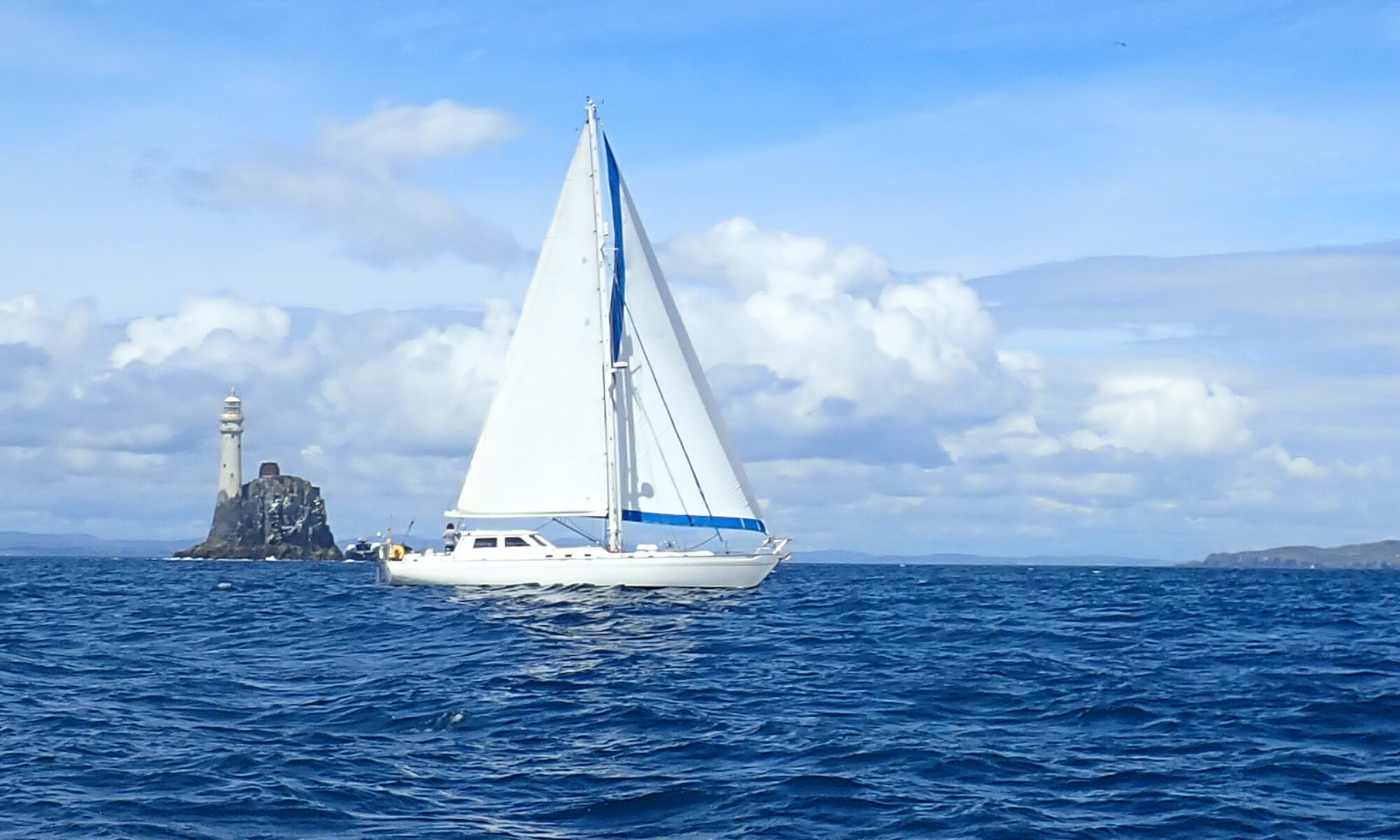


Hi to everyone! In my last blog we visited Victoria in Australia to reset our New Zealand tourist visas for another 6 months. In this edition, I will tell you all about the beauty and the trials and tribulations of cruising the Marlborough Sounds in New Zealand’s South Island. We have stunning anchorages, wild scenery, fun sails, challenging sails, anchoring nightmares, broken windlass’s, crazy tidal streams, lunar eclipses, marina life, bank issues, part procurement, tooth extraction and a visit from a friend. Phew, we better get started then!
Whilst we were in Australia, Azimuth was safely tucked up in Picton Marina and after our long journey home, we took the rest of the day to visit the local supermarket to stock up for another long jaunt in to Marlborough Sounds, our intention to head our way towards Nelson.
The next day, we paid our marina fees and left the dock at Picton, headed to explore more of Queen Charlotte Sound.


First stop, the Endeavour Inlet and the pretty anchorage at Punga Cove. Yes, the inlet was named after Captain Cooks Ship the Endeavour, and he used this inlet as well as resolution Bay and Ships Cove repeatedly. Endeavour Inlet is surrounded on all sides by steep mountains, and as usual in this area, the depth of the water drops steeply from the shore making anchoring difficult. We managed to find a spot on a little sandy shelf in Punga Cove and settled back in to life at anchor again after the whirlwind visit from Ethan and Becky and our side trip to Australia, we were both quite tired!

After a few days, the weather signalled for us to move and we prepared to pull up the hook. Ailsa pressed the button on the windlass …. nothing happened! Uh oh I thought? Here we go again. In the past the culprit in this situation has been the control button that lives in the anchor locker and has a very hard life, regularly covered in sea water. I went to the engine room whilst Ailsa sat on the foredeck repeatedly pressing the button, so that I could see if it was actually driving the solenoid that activates the hydraulics. Lo and behold, there was no clicking sound. I set checking the wiring, first dismantling the button itself, which looked good and then inspecting the wiring from the button to its spur box, where I found a connection that literally crumbled away in my hands, rusted through. I decided to make a permanent improvement this time, and remove this connection all together, extending the wire between the control button and the spur box inside of the forepeak cabin. Belt and braces as they say with no new connection that could corrode in the future.


Feeling confident then, we repeated the test we did earlier, Ailsa on the foredeck pressing the button, and me in the engine room. Click, click, click went the solenoid…. fixed! Whey hey, mini celebration and now I thought we can be on our way? We fired up the engine, and Ailsa pressed the button in expectation, the windlass jumped to life! For all of 20 seconds, before packing up again…. never to work again right up to whilst I am writing this! The start of a saga of anchoring difficulties over the next two months!
Oh well, swearing often helps in this situation, but in this case, it was more about hard graft. Our windlass can be wound manually using a normal winch handle, so up I wound the 40 metres of chain by hand, each metre weighing 3 kilos and the anchor itself weighing 45 kilos. I could only manage one half turn of the winch with a single hard pull (like a rowing stroke I would say) and the chain raised about 15 cms! So it took some time and perseverance before the anchor finally rose out of the water and fought to be pulled over the anchor roller!
Red faced, sweaty and pretty annoyed then we set off to find another anchorage and now thought to ourselves, do we need to return to Picton to get this fixed. A look online and Port Nelson looked to be a better option for a fix with a number of hydraulics engineering firms close to the marina. A plan was hatched to sail to Nelson, about 80 miles away. First stop was further out in to Queen Charlotte Sound to wait for the weather to sail further west, at the anchorage of Ngakuta Bay.


Now this place was magical, we shared it with one other boat for a day before they left and we had the place to ourselves. There was no phone reception and it felt wild and remote. We took the dinghy to shore on a very still evening and watched the stingrays dart around in the mud and stones. All you could hear when the wind dropped was birdsong from the steep hillsides that were covered in thick brush.
A couple of days later the wind shifted as predicted and after the trial of the anchor (the windlass still didn’t work!) we motored out of the bay for an hour before finding some wind in the outer sound and having a beautiful sail past Cape Jackson, a long peninsula at the head of Queen Charlotte, past several other peninsulas and islands and then turning in to take our first look at Pelorus Sound. I shot this video, which if you can, watch on a big screen and relax!


Our anchorage for the next wait for weather was Ketu Bay, another spectacularly beautiful anchorage, peaceful and relaxing, and we were blessed with baking hot still days.
Whilst in the back of my mind, I was preparing myself to get to Nelson and fix our boat problems, it was hard to want to leave this place, and my usual wanderlust kicked in and I started to convince myself that it wasn’t sop hard pulling up the anchor by hand?! This area was the part that we had dreamed about sailing, I wanted to go on and explore and not be forced to have to sail to Nelson to fix the boat! So that is what we decided to do.
Another huge southerly blow was forecast to come through the sounds in the next couple of days, I pulled up the anchor by hand and we motored down a peaceful and flat Pelorus Sound, like a huge Norwegian Fjord, and headed for an area called the Tennyson Inlet and a fantastic anchorage called Worlds End Bay!


Now this really was a superb all weather anchorage, a small inlet led into a large bay surrounded on all sides by lush sub tropical rainforest. The water was flat calm even when the wind gusted through, but most of the time, there was no wind and the place was idyllic.
We rowed to the beach at the head of the bay which was muddy and difficult to access other than at high tide but the place to beach your dinghy was right next to one of the main hiking trails in the area called the Nydia Trail. I am going to put this trail in the top 3 of trails I have walked in New Zealand, taking you from Worlds End Bay high up to a saddle in one direction and round a headland to Duncan Bay in the other direction. The complete trail is about 35kms, maybe one day I will walk the whole thing. Here is a flavour of the walk in the next video:


After a week or so enjoying this fine anchorage, we decided to head further in to Pelorus Sound to explore the inner sounds. I chose a day which looked like it could be sailed and after a little motoring to get out of the Tennyson Inlet we found some beautiful downwind sailing in outer Pelorus. The wind died as we reached Tawero Point, a conspicuous headland that guard the entrance to Inner Pelorus Sound and we fluked round with the tidal stream and a few puffs of wind. Then all hell broke loose! The wind would cycle between 30 knots and about 5 knots ahead of the beam. One minute we would be in a torrent of white water and spray, heeled over hard, the next the sea went flat and the wind died. It made for some crazy sailing, the sound is narrow and there was a lot of other motor boat traffic too. Eventually as we reached further in to the Sound and headed for the Nydia Inlet, the wind died altogether and we were forced to motor the last mile or so to our next anchorage called Chances Bay.
Chances Bay was another fantastic anchorage from a visual sense and should have been on paper a nice place to hide out the fickle winds of this area. We were awoken that night by the anchor alarm squawking in virtually no wind, a few gusts up to 20 knots? What gives I thought? I checked the plotter, and we had indeed dragged 20 or so metres towards the East shore of the bay. Not wanting to have to reset the anchor in the middle of the night, we fired up the engine and dragged Azimuth back to the middle of the bay looking to see if the anchor would bite. It wouldn’t! So Ailsa sat up on anchor watch for a couple of hours, there was no more wind and the boat stayed put. It seemed that Chances Bay was horrible soft mud, of the type that our old delta anchor just never holds in. We decided to move the next day and find a better anchorage further in to the sound.
Now we were getting in to the parts of the Sounds that we had explored by road in 2025, these were the bits I had really been looking forward to.
We had wind to sail down the inner Pelorus Sound towards the little town of Havelock.


For our next anchorage we tucked in behind Putanui Point. Another wonderful anchorage with huge views. We had a quiet night, but the next day the anchor dragged again! Forcing us to make a decision to another location with the usual lifting the anchor by hand.
This time we headed in to Kenepuru Sound, dropping the hook in Ratahi Bay, next to a pretty resort. This time the anchor appeared to hold. For a couple of days anyway! We visited the shore to go for a walk and see the views of the Sound.


Its a very special place, and I would have loved to explore more of it but … yes, we dragged again! It seems we had met our nemesis when it came to the soft mud that seems to be in every anchorage in the inner sound. We tried another spot in the same bay with no luck. The wind got up a little, and we were forced to retreat back to Putanui Point and pick up a local yacht club mooring ball for the night, in desperation really.
The next day, we debated the anchoring problem and decided we would just have to try further out of the sound and see if the holding was any better? We waited for the tide and motored the 10 or so miles out to Wilson Bay, near the entrance to Inner Pelorus Sound. it was another anchor fail! Dispirited then, we spent to the rest of the day motoring back to the Tennyson Inlet and Worlds End Bay, where we dropped the hook, (and it held!) and licked our wounds!
Well, as I was writing this, I thought to myself, there’s a song in this, surely? Anchoring woes, dragging through soft mud, with our Lewmar Delta Anchor? Cue AI to write me some lyrics!
🎶 The Delta Anchor Blues
(Original lyrics)
Verse 1
We left Pelorus early, thought the day was lookin’ fine,
Azimuth humming steady on that silver morning shine.
But the mud was soft as butter, and the tide kept changin’ cues—
By Chances Bay we already had those Delta Anchor Blues.
Verse 2
Slipped round Putanui Point, tried to drop the hook again,
Watched her skate across the bottom like she didn’t have a friend.
Gave her chain, gave her throttle, gave her every trick we knew—
Still that Lewmar Delta whispered, “I ain’t holdin’ here for you.”
Chorus
Oh, we got the Delta… the Delta Anchor Blues,
Draggin’ through the Sounds like she’s got nothin’ left to lose.
From Ratahi to Wilson Bay, she just slid on through—
Till we ran back home to Worlds End, where she finally dug in true.
Verse 3
Ratahi Bay was peaceful, but the bottom wasn’t kind,
We circled like a seabird tryin’ to make up its own mind.
Wilson Bay looked perfect, but the mud said “not today”—
And Azimuth just sighed as we slowly motored away.
Chorus
Yeah, we got the Delta… the Delta Anchor Blues,
Soft mud beneath our keel, and a hook that won’t enthuse.
Every bay we tried to love just turned into bad news—
Till Worlds End wrapped around us like a harbour built to choose.
Bridge
But when that anchor bites at last, and the chain goes tight and clean,
You forget the dance of draggin’ that you’ve done in every scene.
Worlds End Bay, she holds us fast, like she knows what we’ve been through—
A quiet place for sailors with the Delta Anchor Blues.
Final Chorus
Oh, we beat the Delta… the Delta Anchor Blues,
Found a patch of heaven where the mud can’t refuse.
Azimuth rests easy now, in that still and sheltered cove—
Worlds End Bay forever, that’s the anchorage we love.
And of course, cue Suno to write the music, here we go! In that famous line in the Blues Brothers: “We got both kinds of music … Country and Western” I present “The Delta Anchor Blues”, surely destined to be a huge hit!
Dodgy sailing songs aside, disappointed was really the word! The scenery of Inner Pelorus and Kenepuru sounds was fabulous and I so wanted to explore further, but without a windlass, and the terrible holding, it was really quite impossible. So instead we enjoyed the peace and tranquillity of Worlds End Bay for another week or so and were happy with our lot.
We had made plans for Katy, our old friend from the UK who now lives in Wellington to come and visit us on the boat. We tried to organise that for Worlds End Bay, but that proved to be too remote and difficult to get to, so we agreed with Katy that we would meet her in Nelson instead. It was time to make our way to Nelson Marina. We had a great sail from Worlds End, out of Pelorus Sound and down in to Admiralty Bay, where we had another anchoring fail! This time, it was just a matter of the depth rather than the holding, and so I made a decision to make our way through a notorious channel called French Pass, where a tidal stream can flow up to 7 knots turning an underwater reef in to white water. We arrived at the pass not long after the tidal stream had turned in the direction we wanted to go and we whisked through the race at 12 knots! It was exhilarating, and we caught it on the video below.

Another few hours of sailing had us arriving at Whangarea Bay where thankfully the anchor held beautifully, and it turned out to be a fantastic location to view the recent total eclipse of the moon that was exclusive to this part of the planet.


It was a cold and exceptionally clear night for the eclipse and we watched in fascination as the shadow of the Earth moved slowly across the very bright full moon, which eventually turned a deep red colour. At that point the sky was littered with stars, one of the best shows of the milky way we have seen in NZ punctuated by the blood moon.


A memorable evening. My attempts to photograph the eclipse were a failure, so I have stolen some pics from the internet! Through binoculars, it truly did look like this:


The final leg of our sail down to Nelson was uneventful and we fought the tide to get in to Nelson Haven, which is a dredged big ship channel behind a huge natural spit of land that extends all the way across Nelson Bay. The marina staff couldn’t have been more helpful to guide us in to our slip and we tied up and stepped on to dry land once again. Here’s a video of the highlights of our sail from Worlds End Bay in Tennyson Inlet all the way to Nelson.


That night we visited the local yacht clubhouse at the marina, the Tasman Cruising Club and met some of the locals, enjoyed a beer or two and steak and chips, for our first night out back in civilisation.
We took a walk in to Nelson and enjoyed the Saturday market stocking up on excellent and cheap veggies, and started planning for longer term provisioning for our South Pacific adventure that is not far away. There have since been MANY trips to the supermarket!
As Monday morning came round, I dove in to find people to fix the various boat problems. A long standing issue has been that we lost the autopilot on the sail over the Cook Straits back in December 2025. Since then, we have been sailing everywhere hand steering. As fun as that has been, its not something we would want to do for anything more than a day sail, for example we need to do the 3 day sail soon to get back to the North of New Zealand, as well as the longer sails that are coming up to get back to the South Pacific Islands. The problem was that my wooden mounting that I devised all the way back in Colombia, and that has lasted all the way to the Cook Straits had snapped. I designed a mounting bracket to be made from steel, and so that day I set out to find a metal basher who could fabricate it for me. Thankfully a workshop called Fabriweld came to my rescue, they agreed to squeeze the job in, they did an excellent job and charged very little for their efforts.
Next on the list was the windlass. Just near the marina was a hydraulics workshop and sales company called Fluid Power Solutions. I went down to have a chat with them, met the workshop manager and he arranged for one of his engineers to come out to the boat that afternoon and take a look. I suspected the hydraulic pump that is powered by the engine was the problem, because, not only did the windlass not work, neither did the bow thruster too that was driven by the same pump. I could see that the hydraulic lines no longer pressurised when you pressed a button for the windlass or the bow thruster. Sam, the engineer, a bloke originally from Leeds in the UK, took a look and decided to take the pump back to their workshop to dismantle and inspect it, and he let me come along too so I could see how the thing worked. He couldn’t find anything wrong with it, apart from some of the oring seals inside the pump looked worn. So we returned to Azimuth to look at the clutch drive unit that actually drives the pump. I started up the engine whilst he watched. There was a horrible squealing noise from the drive belts which started smoking under the strain. Sam shouting at me to turn off the engine! It seems the clutch was burnt out and completely seized up, absolutely the prime culprit. So we removed this, dismantled it back at their workshop and removed the charred remains of the clutch! It was quite troubling, as presumably if we had run this any longer it could have been a fire risk.

The saga continued for this job though. Finding replacement parts, a seal kit for the pump and a new clutch was nigh on impossible! After 3 weeks of looking, the company had tracked down someone who could supply the seal kit, where the minimum order was 5 kits (at 200 quid each!) and a lead time of 3 months! We also had not been able to track down a replacement clutch unit. We were facing a tough choice, we could carry on looking or potentially buy a whole new replacement with reengineering of the fitting on the engine. The estimate was about 3000 to 5000 quid… ouch.
Armed with the part numbers, I went on a marathon internet search. I found the seal kit in stock in a hydraulics firm in Lithuania, where I have ordered two kits including postage for 180 quid. I also found two clutches on Ebay in the USA including shipping for 200 quid. IF they turn up, we shall be able to fix the pump and have spare parts too for about 400 quid. We await to see if the parts arrive towards the end of April?!
One weekend we took a long walk in the hot sun to climb up a local hill and see the “Centre of New Zealand”. It was a steep climb and whinge power alone allowed Ailsa to get to the top. Some great views were to be had.


Life at sea is so much easier than being a land lubber! On arriving in Nelson, we were to be beset with land lubber problems. I have an old iPhone SE from 2016 which has been serving me well for the last 10 years, although the battery does not last long. We arrived in Nelson to find that we could no longer make or receive phone calls? It seems that NZ in their wisdom had turned off all 3G networks in the country that month and neither my aging phone or Ailsa’s aging Samsung phone would work for voice calls! I needed the phone to talk to all these contractors for the various boat jobs. This also happened to coincide with the decision by my UK bank account to decide that I was spending my money unwisely and they decided to disable my card. So now I had no bank access and my phone was on the blink! That was a difficult day and surely is a land lubber problem! In the end I managed to coerce my old iPhone to allow WIFI calls, and the bank was able to call me through our Starlink internet connection. Flip me, these things are sent to try you. Yes, I have succumbed to a new (second hand!) iPhone.
Another land lubber issue is the visiting of dentists! Ailsa decided she needed to have a check-up at the dentist, given that we are going to be heading off back to the blue waters of the Pacific soon where dentists are few and far between. I don’t know if she regretted that visit, but it resulted in her having to have a molar extracted due to it being forced upwards by one of her wisdom teeth. She is in slow recovery now! Wine apparently helps a lot!

After all the issues with anchoring, we decided to bite the bullet and purchase a new anchor for Azimuth at the local chandlers, Burnsco. In NZ, all foreign flagged boats get to buy boat parts without VAT (or GST as they call it here). That’s a 15% saving, and makes NZ very cheap. So we have a shiny new 56kg spade anchor on the front of Azimuth now, and are hopeful that this will solve out “Delta Anchor Blues”!


Our friend Katy did make it to Nelson! She had one failed attempt when the airline decided to cancel her flight from Wellington, but the next weekend, she flew out and met us on the boat on the Saturday morning. We took her in to Nelson for the day where we pottered about, visited a couple of pubs and ended up at a restaurant for dinner in the popular Trafalgar square district in the town centre.
The next day was glorious sunshine and we headed out for a walk along the coast, visiting some Japanese gardens and then swinging back in to town for a quick pub stop. A visit to the supermarket and we bought some provisions to return to Azimuth to cook roast lamb with all the trimmings for dinner that evening.
It was lovely to catch up with Katy again, we had a very relaxing weekend and lots of reminiscing about old times back in Notts! Thanks for making the effort Katy, we really enjoyed having you to visit.


We have left Nelson now and are sitting at anchor in the Abel Tasman National Park we will tell you about that next time, and the outcome of the repairs. All the best for now.
Dom & Ailsa on Azimuth.


